 AIR
Best Air Purifier for Pets in 2026: Dander, Hair & Odor Picks
Our Top Pick Category Product Why It Wins Best Overall for Pet Owners Winix C909 Washable pre-filter, True HEPA, and real AHAM-verified…
Read article
 By aquairpure·
·11 min read
We may earn a commission when you buy through our links. It never affects our scores.
You turn the heat up, and somehow the house feels worse. Lips crack. Doorknobs bite back with a static zap. The hardwood floor opens a gap you could lose a coin in.
The furnace isn’t broken. It’s doing exactly what it was built to do: heat cold winter air that holds very little moisture. A humidifier on the furnace puts that moisture back, in every room, without a single tank to refill.
But it isn’t right for every home. Set it too high and you trade dry skin for foggy windows and mold. This guide covers how furnace humidifiers work, which type fits your house, what they cost, and the one setting most guides skip.
Quick answer: A furnace humidifier is a whole-home unit mounted on your furnace ductwork and plumbed to a water line. It adds moisture to heated air before it reaches your rooms, aiming for 30–50% indoor humidity. It’s worth it in cold, dry climates if your ducts are inside the heated space and you’re willing to lower the setting on very cold days.
A humidifier on the furnace is a whole-house humidifier mounted directly on your forced-air heating system. You’ll also hear it called a furnace-mounted, HVAC or central humidifier. It all means the same thing.
It connects to three things:
The idea is simple. Instead of humidifying one bedroom with a tabletop unit, you humidify the air at the source, and your ducts carry it everywhere the heat goes.
Almost any home with a forced-air furnace can add one. Homes heated by radiators, boilers or baseboard heat have no ducts to share, so they need a different solution.

Think of it as a waterfall inside your ductwork. Warm air picks up moisture as it passes through, the same way wet laundry dries faster on a warm day.
Here’s the cycle, step by step:
Warm air matters here. It can hold far more moisture than cold air, which is why the humidifier works alongside the furnace instead of on its own.
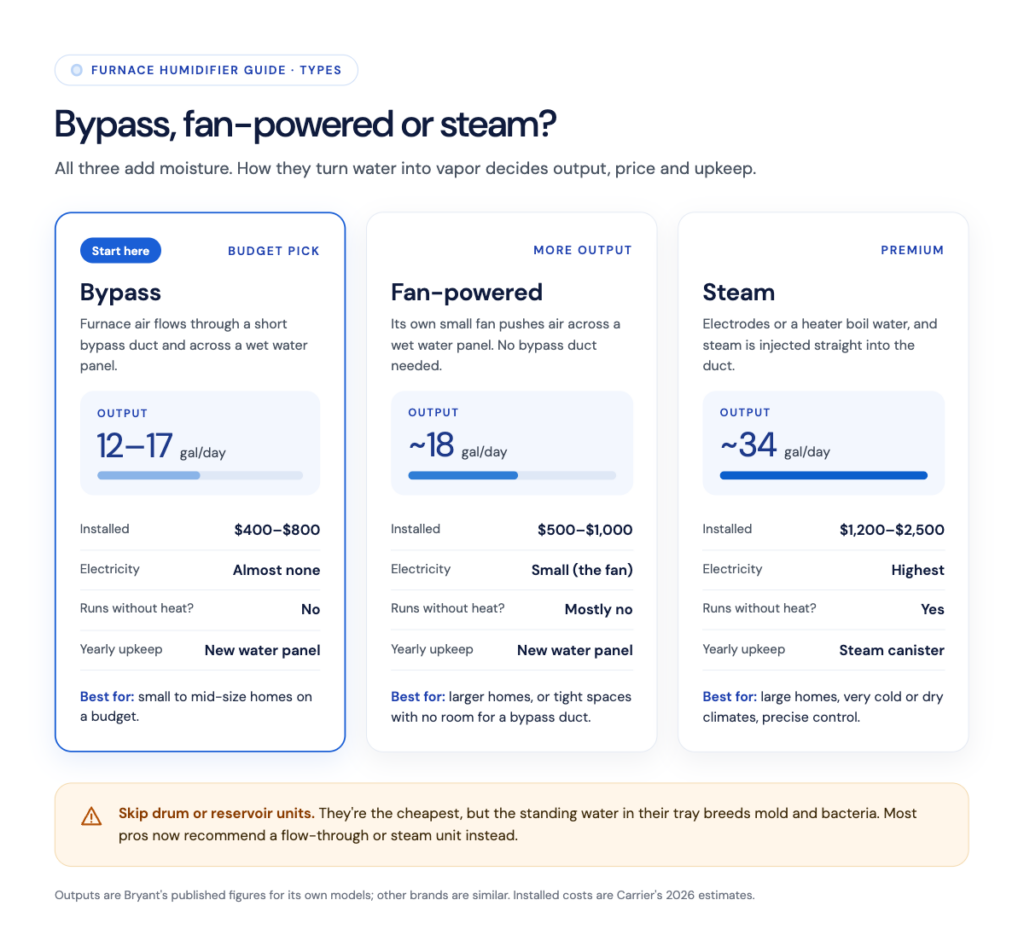
Every furnace humidifier does the same job. What changes is how it turns water into vapor, and that decides output, price and upkeep.
| Bypass | Fan-powered | Steam | |
|---|---|---|---|
| How it makes moisture | Furnace air flows through a short bypass duct and across a wet water panel | Its own small fan pushes air across a wet water panel | Electrodes or a heater boil water; steam is injected into the duct |
| Typical output | Up to 12–17 gal/day | Up to ~18 gal/day | Up to ~34 gal/day |
| Works only when the furnace heats? | Yes | Mostly, but it doesn’t rely on a bypass duct | No, it can run on its own |
| Electricity use | Almost none | Small (the fan) | Highest (boiling water) |
| Installed cost | $400–$800 | $500–$1,000 | $1,200–$2,500 |
| Yearly upkeep | Replace water panel | Replace water panel | Replace or clean steam canister |
| Best for | Small to mid-size homes on a budget | Larger homes, or tight spaces with no room for a bypass duct | Large homes, very cold or dry climates, precise control |
Outputs are Bryant’s published figures for its own models; other brands are similar.
Bypass is the classic, budget-friendly choice. It has almost nothing to break: a damper, a fill valve and a drain. The trade-off is that it only humidifies while the burner fires, and it sends a little heated air back to the return side of the furnace.
Fan-powered adds a small blower so it can push more air through the pad. That means more moisture and more flexible placement, since it doesn’t need a bypass duct.
Steam is the premium option. Because it boils its own water, it can add moisture even when the furnace isn’t heating, and it’s the most precise. It costs the most to buy and to run.
Older style to know: drum or reservoir humidifiers hold standing water in a tray. They’re the cheapest, but standing water breeds mold and bacteria, so most pros now recommend a flow-through or steam unit instead.
The payoff shows up in three places: your body, your house and, sometimes, your heating bill.
Your body
Your home
Your comfort (and maybe your bill)
Humid air feels warmer than dry air at the same temperature. Some homeowners find they can nudge the thermostat down a degree or two without feeling colder. Carrier and Bryant both say the savings vary by home and aren’t guaranteed, so treat it as a bonus rather than the reason to buy.
Zero daily hassle
Unlike a tabletop unit, there’s no tank to fill, no carrying jugs of water, and nothing to forget. It runs on its own whenever the humidistat calls for moisture.

Here’s the step most guides skip: measure before you buy. A $10–$70 hygrometer (humidity gauge) tells you your real indoor humidity. If it reads in the mid-20s or lower for weeks at a time in winter, a humidifier will likely help.
Run through these questions:
Mostly yes? A furnace humidifier is a strong fit. Several no’s, especially on the last three? Read the next section before you buy.
Your furnace doesn’t actually remove water from the air. The real culprit is air leakage. Cold outdoor air leaks in through gaps around doors, windows and plumbing or wiring holes. Once heated, that air holds very little moisture, so your indoor humidity drops.
That’s why some HVAC pros, like PV Heating, Cooling & Plumbing in Atlanta, recommend air sealing before adding a humidifier. Seal the leaks and you let in less dry air, keep more of the moisture you already make from cooking and showers, and cut heating costs at the same time. A blower door test can pinpoint the biggest leaks.
In mild climates, air sealing plus a bedside humidifier may be all you need.
A furnace humidifier solves dry air, but it can create a moisture problem if it’s oversized, over-set or neglected.
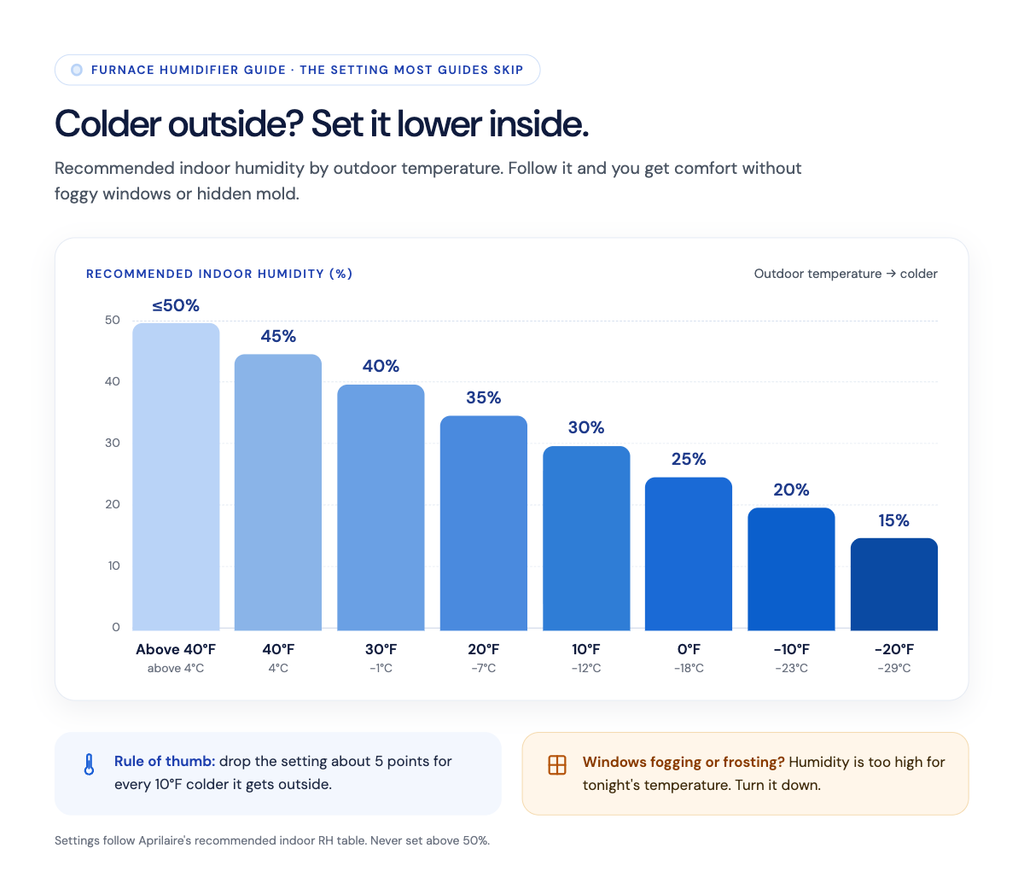
How to avoid almost all of it: keep humidity at or below 50%, lower it as outdoor temperatures fall (see the chart above), and set the unit to run only when the furnace is heating if your ducts pass through cold spaces.
Most homeowners pay $400 to $1,200 to add a bypass or fan-powered humidifier to an existing furnace, installed. Steam runs higher. HomeAdvisor puts the national average at about $579.
| Cost item | Typical range |
|---|---|
| Bypass, installed | $400–$800 |
| Fan-powered, installed | $500–$1,000 |
| Steam, installed | $1,200–$2,500 |
| Water panel (bypass and fan) | $10–$50 per pad, replaced yearly |
| Steam canister | About $100 when replaced |
| Average repair | About $230 |
| Expected lifespan | 10–15 years with maintenance |
Installed ranges are Carrier’s 2026 estimates; average, pad, repair and lifespan figures are from HomeAdvisor; canister price from Sylvane.
What pushes the price up: a cramped attic or crawl-space install, extra ductwork, a new electrical circuit for steam, a condensate pump if there’s no floor drain nearby, and higher local labor rates.
How to pay less:
Will it pay for itself? Probably not through energy savings alone. Carrier’s own example: a $1,500 install that saves $150 a year takes 10 years to pay back. Most people buy one for comfort and to protect their floors and furniture.
Hire a pro unless you’re comfortable cutting sheet-metal ductwork, tapping a water line and wiring low-voltage controls. The installer also sizes the unit to your home, climate and air leakage, which matters more than square footage alone. Many manufacturer warranties also require professional installation, so check before you DIY.
In spring, reverse it: close the damper, close the water valve and turn the humidistat off. Leaving a bypass damper open in summer lets cooled air loop back to the return, which wastes air-conditioning capacity.
Pro tip on water: steam humidifiers generally work best with normal tap water. Heavily softened or reverse-osmosis water can stop some electrode-type steam units from working properly, according to a Bryant dealer.
Not sure you need the whole-house version? Here’s how they stack up.
| Furnace (whole-house) humidifier | Portable humidifier | |
|---|---|---|
| Coverage | Every room the ducts reach | One room |
| Refilling | Never; plumbed to a water line | Daily or every few days |
| Upfront cost | About $400–$2,500 installed | Low; buy and plug in |
| Control | Wall or duct-mounted humidistat | Basic dial or built-in sensor |
| Upkeep | Yearly pad or canister change | Frequent cleaning to prevent bacteria |
| Works without forced air? | No | Yes |
| Best for | Cold-climate homes with dry air in every room | Renters, mild climates, a single bedroom or nursery |
The short version: if dry air is a whole-house, every-winter problem, go central. If it’s one stuffy bedroom, start portable.
Almost any forced-air furnace or heat-pump air handler can take one, as long as there’s room on the ductwork and a water line nearby. Boiler, radiator and baseboard systems can’t.
In cold, dry climates, usually yes, especially if your indoor humidity sits below 30% for weeks. In mild climates or leaky homes, air sealing and a portable unit may be the better first move.
Between 30% and 50% in general, but lower it as it gets colder outside. At 0–10°F, aim for 30% or less. If windows fog or frost, turn it down.
Can a furnace humidifier cause mold? I
t can if humidity is set too high, ducts run through cold spaces or the unit isn’t maintained. Kept at the right level and serviced yearly, the risk is low.
Look for water draining from the unit during or just after a heating cycle, and watch a hygrometer climb toward your setpoint over a day or two.
Yes. Turn off the humidistat, close the water valve and, on a bypass unit, close the damper.
About 10–15 years with yearly maintenance.
It varies by type and model. Steam units turn nearly all their water into vapor, while bypass and fan-powered units send some down the drain. Water-saver pads reduce waste.
A humidifier on the furnace is one of the simplest comfort upgrades for a cold-climate home. It ends the static shocks, the cracked skin and the gapping floors without a single tank to fill.
Just buy it with your eyes open. Measure your humidity first, seal obvious air leaks, choose bypass unless you truly need more output, and lower the setting as winter deepens. Do that, and you get the comfort without the foggy windows.
AIR
Our Top Pick Category Product Why It Wins Best Overall for Pet Owners Winix C909 Washable pre-filter, True HEPA, and real AHAM-verified…
 AIR
The question we get most about PFAS is not what are they? It is is it in my water, and does my…
 AIR
The question we get most about fluoride isn’t is it safe? I bought a filter pitcher, so the fluoride is gone, right?…
 AIR
Our Top Pick Category Winner Price Why Best Overall for Small Rooms Levoit Core 300S $149.99 AHAM Verifide certified, sized correctly for…