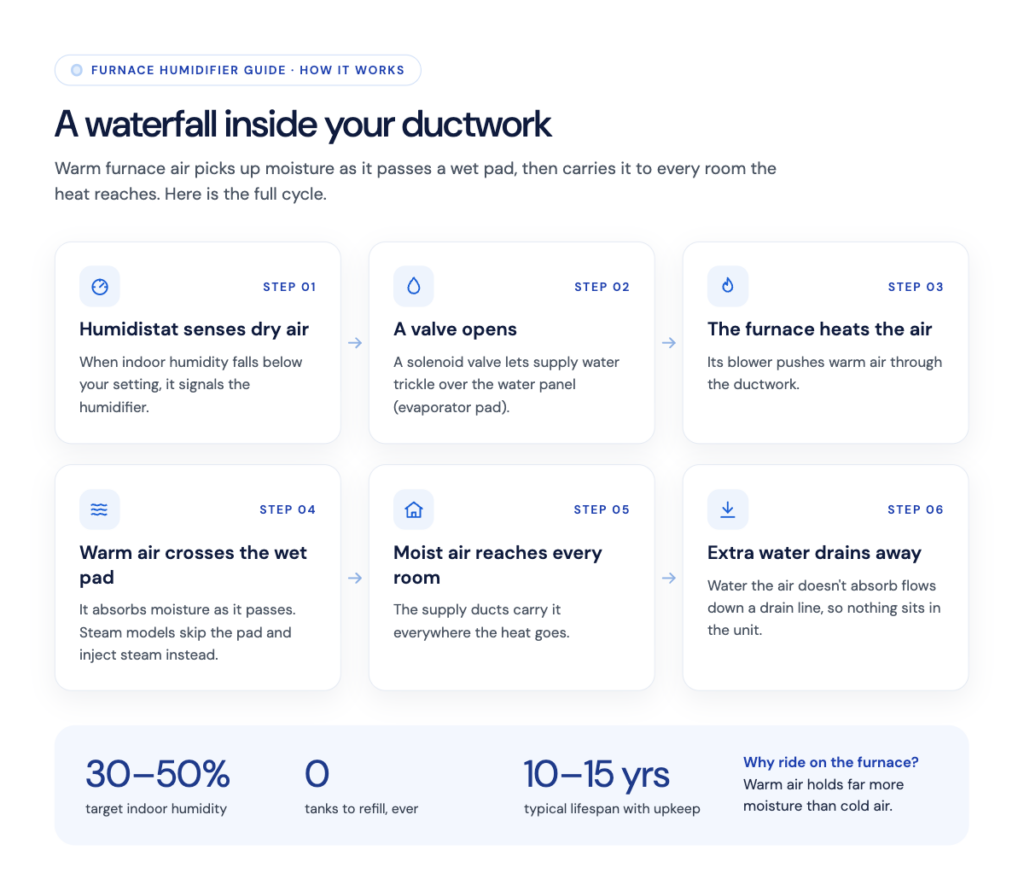
 AIR
Humidifier on the Furnace: How It Works, Types, Costs and Whether You Need One
You turn the heat up, and somehow the house feels worse. Lips crack. Doorknobs bite back with a static zap. The hardwood…
Read article
 By aquairpure·
·14 min read
We may earn a commission when you buy through our links. It never affects our scores.
The question we get most about PFAS is not what are they? It is is it in my water, and does my filter do anything about it?
Fair question. PFAS are measured in parts per trillion, the federal rules have been rewritten, proposed for rollback and argued in court within two years, and the filter aisle is full of boxes that say “reduces PFAS” without telling you how much.
So this guide sticks to what can be checked: the current federal limits (and what is in flux as of September 2026), how common PFAS are, how to look up your system, and which treatments have evidence behind them. One popular method makes things worse. Short version: you probably can find out your number for free, and if you need to lower it, a certified under-sink system does the job far more reliably than a random pitcher.
PFAS (per- and polyfluoroalkyl substances) are a large family of synthetic chemicals that resist heat, water and oil. The USGS notes there are more than 12,000 types of PFAS, of which its tap water study looked at 32 (USGS). The “forever nickname comes from persistence: EPA says many break down very slowly and can build up in people, animals, and the environment over time (EPA). They got into water from firefighting foam, industrial sites and consumer products, which is why hot spots cluster near airports, military bases and manufacturing.
One practical point before the numbers: a part per trillion (ppt) is tiny. That is why PFAS testing needs a specialist lab and why your TDS meter tells you nothing about it (more on that in our TDS guide).
EPA finalized the first national PFAS drinking water standards on April 10, 2024 (EPA):
| Compound | Health goal (MCLG) | Enforceable limit (MCL) | Proposed status (May 2026) |
|---|---|---|---|
| PFOA | Zero | 4.0 ppt | Keep limit, compliance moved to 2031 |
| PFOS | Zero | 4.0 ppt | Keep limit, compliance moved to 2031 |
| PFHxS | 10 ppt | 10 ppt | Rescind |
| PFNA | 10 ppt | 10 ppt | Rescind |
| HFPO-DA (GenX) | 10 ppt | 10 ppt | Rescind |
| Mixture of PFHxS, PFNA, GenX and PFBS | Hazard index of 1 | Hazard index of 1 | Rescind |
Sources: EPA PFAS NPDWR, EPA rescission proposal, EPA compliance extension proposal.
Under the 2024 rule, utilities had three years (by 2027) to finish initial monitoring and five years (by 2029) to fix any exceedances (EPA). EPA projected the rule would prevent PFAS exposure in drinking water for approximately 100 million people (same source).
Our read, dated 21 September 2026: neither proposal is final, and we found no court ruling yet. The 4.0 ppt limits for PFOA and PFOS have survived every version so far, so that is the number we would use to judge your water. The fate of the other four limits is an open question. We will update this section when EPA finalizes or the court rules.
Some states did not wait. Pennsylvania, for one, adopted its own PFOA and PFOS limits in January 2023 (PA DEP), and Illinois has state standards for six PFAS (Illinois DPH). Your state rule may be stricter or sooner than the federal one.
Two big datasets, measuring different things.
USGS tap water study (2023). USGS sampled tap water at 716 locations between 2016 and 2021 and estimates that “at least 45% of the nation’s tap water” has one or more PFAS. Detection was more likely in cities: roughly a 75% probability of no detection in rural areas versus about 25% in urban ones. The most frequent compounds were PFBS, PFHxS and PFOA (USGS). That study included private wells as well as public supplies, which matters because private wells get no federal PFAS testing at all.
UCMR 5 (EPA’s national utility monitoring, 2023 to 2025). EPA’s July 2026 data summary covers about 10,130 public water systems and 25,950 sampling points. Key numbers (EPA UCMR 5 data summary):
The two studies do not contradict each other. USGS measured at the tap, including wells; UCMR 5 measured at utility sampling points against fixed reporting levels (4 ppt for PFOA and PFOS). Detection is common. Exceeding the limit is less common, but not rare.
EPA lists these effects linked to exposure to certain PFAS in peer-reviewed studies (EPA):
ATSDR is more specific about which chemicals the human evidence points to, for example Kidney and testicular cancer (PFOA) and Lower antibody response to some vaccines (PFOA, PFOS, PFHxS, PFDA). It also flags “inconsistent findings among human studies” and says risk depends on exposure level and individual factors (ATSDR).
In December 2023 the WHO’s cancer agency classified PFOA as carcinogenic to humans (Group 1) and PFOS as possibly carcinogenic to humans (Group 2B) (IARC).
What this does not mean: a single glass of water at 6 ppt will make you sick. The concern is long-term, cumulative exposure, which is exactly why EPA set the health goal for PFOA and PFOS at zero. If you are pregnant, or making formula for an infant with tap water, you have the strongest reason to find out your number.
Your utility’s annual water quality report is the first stop. Federal rules require it to include contaminants monitored under the unregulated contaminant program, with the average and range detected (40 CFR 141.153). So if your system sampled for UCMR 5, PFAS results should appear, often in a separate “unregulated contaminants” table that people skip. EPA links to local reports from its CCR page. Our CCR guide explains how to read one.
EPA’s UCMR 5 Data Finder lets you filter by system name or ID, state and contaminant, and compare averages to the 2024 limits. EPA says the final dataset was released in August 2026. Tip: search by your utility’s name or its PWS ID, which is printed on your CCR.
The EWG PFAS contamination map shows 9,728 sites (as of its March 2026 update) and pulls from UCMR 5, state reports and Department of Defense records. It is a good quick scan. But it mixes water systems with military and industrial sites, locations are approximate, and EWG’s own benchmark (1 ppt) is stricter than the federal limit. A dot near your house is a reason to look up your utility’s actual numbers, not a verdict on your tap.
UCMR 5 covers public systems only. If you are on a well near an airport, base, landfill or factory, get a lab test from a state-certified lab using an EPA drinking water method: Method 533 measures 25 PFAS and Method 537.1 measures 18, including GenX (EPA). Illinois, for example, advises well owners to use nearby public system results as a warning sign and test if PFAS has been found nearby (Illinois DPH). See our home water testing guide and well vs city water guide. Home test strips are not a substitute at these concentrations.
EPA names three point-of-use technologies: granular activated carbon, ion exchange resin and reverse osmosis (EPA). The best real-world comparison we know of is a Duke University and NC State study that tested 76 point-of-use filters and 13 whole-house systems in North Carolina homes (Duke Nicholas School, EurekAlert). This is their measurement, not ours.
| Method | How well it reduces PFAS | Evidence and source |
|---|---|---|
| Under-sink reverse osmosis | Very effective | 94% or more removal, “near-complete” (EurekAlert); certify to NSF/ANSI 58 (EPA) |
| Two-stage under-sink filters | Very effective | Also 94% or more in the same study (EurekAlert) |
| Activated carbon pitchers, faucet, fridge, countertop | Variable | Average 73%, “inconsistent and unpredictable” (Duke); pick NSF/ANSI 53 certified for PFAS |
| Ion exchange (PFAS-selective resin) | Can be effective | Listed by EPA (EPA); Minnesota says “some” systems may work, choose certified ones (MDH) |
| Whole-house (point-of-entry) carbon | Unreliable unless well maintained | 4 of 6 tested systems showed higher PFAS after filtration (EurekAlert); MDH says point-of-use is usually more economical (MDH) |
| Water softener or iron filter | Does not remove PFAS | “those systems do NOT remove PFAS” (MDH) |
| Boiling | Makes it worse | “It will concentrate (increase the level of) these chemicals” (RI Dept. of Health) |
A few things the table cannot show. RO wastes water; EPA’s estimate is about one gallon wasted per gallon treated (EPA). Every method depends on maintenance: EPA says filters “are only effective if they are maintained according to the manufacturer’s instructions” (same source). A spent carbon cartridge is just a plastic tube. How RO works is covered in our reverse osmosis guide, carbon in our carbon filter guide.
Certification is contaminant-specific. A filter certified for chlorine taste under NSF/ANSI 42 says nothing about PFAS. For PFAS you want one of two claims under NSF/ANSI 53 (filters) or NSF/ANSI 58 (reverse osmosis):
The catch nobody on the box mentions: EPA says current certifications “do not yet indicate that a filter will remove PFAS down to the levels EPA has now set for a drinking water standard” (EPA). The pass line is 70 or 20 ppt, not 4. NSF says updates to align with EPA are in progress (NSF), but WC&P reports the timeline slipped after EPA’s May 2025 announcement (WC&P). A certified system fed typical tap levels (tens of ppt, not 1,500) will often beat the pass line, but “certified” is a floor, not a promise of 4 ppt.
AquaAirPure guidance, not a published standard: prefer the total PFAS claim over PFOA/PFOS only, and prefer RO or a certified two-stage system if your water is above 4 ppt. How to confirm a listing is real: check NSF certification and our NSF certifications explained.
Boiling kills it. Boiling kills germs. PFAS are chemicals that do not boil off, so as water evaporates the PFAS left behind gets more concentrated (RI Dept. of Health, MDH).
My softener handles everything. Softeners swap hardness minerals. Minnesota says plainly they do not remove PFAS (MDH). See softener vs filter.
The EPA cancelled the PFAS rule. Not as of today. EPA proposed dropping four of the six limits and delaying the other two. The PFOA and PFOS limits of 4.0 ppt remain, and nothing is final.
Any carbon filter removes PFAS. Carbon can, but the Duke study found pitcher and fridge carbon filters “inconsistent and unpredictable” (Duke). Certification and cartridge age matter more than the word “carbon.”
EPA’s health goal for PFOA and PFOS is zero, and the enforceable limit is 4.0 ppt each. For PFHxS, PFNA and GenX, the 2024 limit is 10 ppt, though EPA has proposed rescinding those (EPA).
Check your Consumer Confidence Report and EPA’s UCMR 5 Data Finder. If you are on a private well, pay for a lab test, since no federal program tests wells.
Only if that specific model is certified to NSF/ANSI 53 for PFOA/PFOS or total PFAS, and only while the cartridge is fresh. In the Duke study, carbon pitchers averaged 73% removal with wide variation (EurekAlert). Check the certifier’s listing for your exact cartridge.
Yes. Under-sink RO removed 94% or more of PFAS in the Duke/NC State study (EurekAlert). Look for NSF/ANSI 58 with a PFAS claim.
No. Boiling concentrates PFAS (RI Dept. of Health).
Not guaranteed. FDA found detectable PFAS in 10 of 197 samples, all below EPA limits, and there is no FDA bottled water PFAS standard yet (Food Safety Magazine).
April 2029 under the 2024 rule. EPA has proposed moving the PFOA/PFOS deadline to April 2031. As of 21 September 2026 that proposal is not final (EPA).
PFAS show up in a lot of US tap water, and above the federal limit in a smaller but real share. The rules are in flux, but 4.0 ppt for PFOA and PFOS is the number that has survived every rewrite, so use it. Look up your system for free. If you are over, a certified under-sink RO or two-stage filter is the proven fix. Keep the cartridges fresh, and put the kettle away for this job.
For the bigger picture on what else might be in your tap, see our tap water contaminants hub and the water filter guide.
AIR
You turn the heat up, and somehow the house feels worse. Lips crack. Doorknobs bite back with a static zap. The hardwood…
 AIR
Our Top Pick Category Product Why It Wins Best Overall for Pet Owners Winix C909 Washable pre-filter, True HEPA, and real AHAM-verified…
 AIR
The question we get most about fluoride isn’t is it safe? I bought a filter pitcher, so the fluoride is gone, right?…
 AIR
Our Top Pick Category Winner Price Why Best Overall for Small Rooms Levoit Core 300S $149.99 AHAM Verifide certified, sized correctly for…