 AIR
Humidifier on the Furnace: How It Works, Types, Costs and Whether You Need One
You turn the heat up, and somehow the house feels worse. Lips crack. Doorknobs bite back with a static zap. The hardwood…
Read article
 By aquairpure·
Updated
·14 min read
We may earn a commission when you buy through our links. It never affects our scores.
The question we get most about fluoride isn’t is it safe? I bought a filter pitcher, so the fluoride is gone, right?
Usually, no. Fluoride is a small, dissolved ion. It slips through the activated carbon that does most of the work in pitchers, faucet filters and fridge filters. Boiling doesn’t help either: it drives off water and leaves the fluoride behind, slightly more concentrated than before.
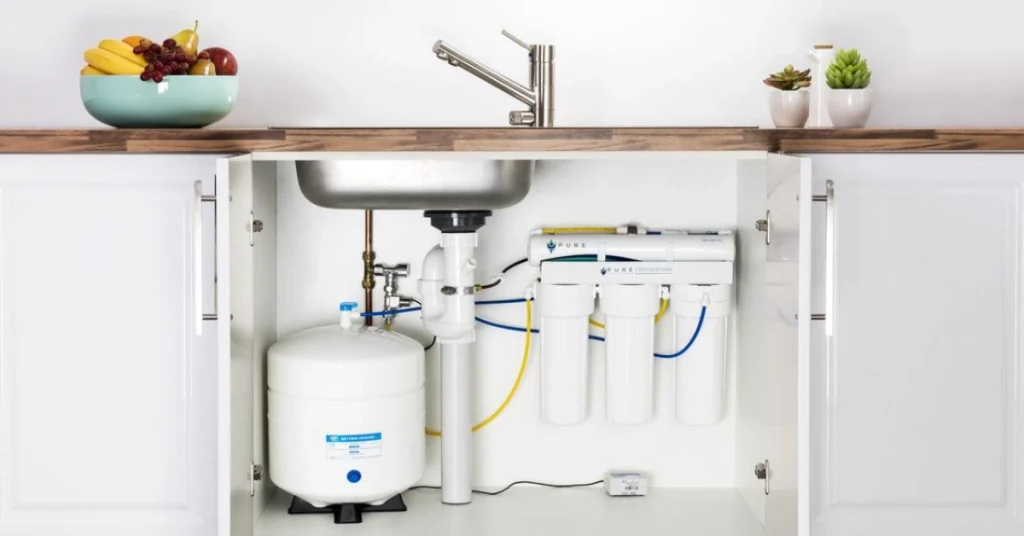
The methods that do work are well known and not exotic: reverse osmosis, activated alumina, bone char and distillation. The catch is that each one has conditions (pH, flow rate, maintenance) that the product pages tend to skip.
This guide covers what each method removes, what it costs to live with, how to confirm a product’s claim, and where the science and the law stand as of September 2026. We try to stay out of the politics. Whether you want less fluoride because of the new research, because your well is naturally high, or because you just prefer it, the removal chemistry is the same.
Before choosing a filter, get the number. It decides whether you need removal at all and how much capacity you need.
On city water: your utility’s annual water quality report lists fluoride. See our guide to reading a Consumer Confidence Report. CDC’s own advice is blunt: “The best source of information on the fluoride level of your drinking water is your local water provider.” Systems that fluoridate aim for 0.7 mg/L; systems that don’t usually sit lower, depending on the source.
On a private well: nobody is checking for you. A 2020 USGS assessment of 16,441 wells found fluoride above the 4 mg/L MCL in 1.6% of all wells and 0.6% of domestic wells, and estimated about 172,000 people rely on domestic wells above 4 mg/L, with roughly 522,000 on domestic wells above 2 mg/L. The same study found more than 85% of wells were below 0.7 mg/L. Concentrations were generally higher in the western US. In USGS’s words, “Groundwater from domestic wells typically is not treated to lower elevated fluoride concentrations nor is fluoride added if concentrations are low.”
Use a state-certified lab. Fluoride is one of the standard inorganic tests, and most well panels include it. A few practical points:
| Level | What it is | Source |
|---|---|---|
| 0.7 mg/L | US Public Health Service recommended level for systems that add fluoride (set 2015, replacing a 0.7 to 1.2 mg/L range) | Federal Register, 1 May 2015 |
| 1.5 mg/L | WHO guideline value; also the level above which NTP found an association with lower IQ in children (moderate confidence) | NTP |
| 2.0 mg/L | EPA secondary standard (not enforceable), set for “tooth discoloration” | EPA secondary standards |
| 4.0 mg/L | EPA enforceable MCL (and MCLG), set 1986; health effect listed as bone disease, and “Children may get mottled teeth” | EPA NPDWR table |
If your well is at or above 4.0 mg/L, this stops being a preference question. CDC itself says to “Consider using a filter that removes fluoride from water used for drinking or cooking” at that level.
We’ll keep this short and dated, because it keeps moving.
CDC calls community water fluoridation “a cornerstone strategy for prevention of cavities” and says it reduces cavities by about 25% in children and adults. The American Dental Association “unreservedly endorses the fluoridation of community water supplies as safe, effective and necessary in preventing tooth decay.” Real-world evidence from places that stopped: after Juneau, Alaska ended fluoridation in 2007, a BMC Oral Health study of Medicaid-eligible children found more cavity procedures after cessation and a 73% increase in inflation-adjusted cavity treatment costs for children under 7. Calgary stopped in 2011 and later voted to restore it, a story PBS covered in detail.
In August 2024 the National Toxicology Program concluded, with moderate confidence, that “higher levels of fluoride exposure, such as drinking water containing more than 1.5 milligrams of fluoride per liter, are associated with lower IQ in children.” The same review said “there were insufficient data to determine if the low fluoride level of 0.7 mg/L currently recommended for U.S. community water supplies has a negative effect on children’s IQ.” Both halves of that matter. It’s a finding about levels above 1.5 mg/L, drawn mostly from studies outside the US, and it doesn’t settle the question at 0.7 mg/L in either direction.
No further statewide bans have passed in 2026 as of CareQuest’s tracking, though local decisions continue. Our read: the federal MCL of 4.0 mg/L is still the enforceable number today, and anyone telling you the final answer is in hasn’t been reading the dockets.
RO pushes water through a membrane that rejects dissolved ions, fluoride included. The Water Quality Association’s fact sheet puts rejection at “80-90 percent” for older cellulose membranes and “up to 95 percent” for thin-film composite membranes, which is what nearly every current under-sink unit uses. The ADA’s Fluoridation Facts says “Almost all reverse osmosis systems and distillation units remove most of the fluoride.”
How to verify a claim: NSF/ANSI 58 includes “Fluoride reduction” as an optional claim. Not every certified RO system carries it. A system that does lists fluoride on its performance data sheet with a 1.5 mg/L product water limit (one example: this Aquasana RO data sheet reports 95.7% fluoride reduction). Check the NSF listing, not the box. Our guides on NSF certifications and how to check a certification walk through it.
Trade-offs: RO sends some water to the drain (older designs send most of it; Virginia Tech’s extension guide notes only “Ten to twenty percent” exits as treated water on those), needs decent water pressure (WQA says at least 30 psi), and strips minerals along with fluoride. It also removes a long list of other contaminants, which is the real reason we recommend it as the default. How it works in detail: how reverse osmosis works.
Activated alumina (aluminum oxide granules) adsorbs fluoride. A review by the International Groundwater Resources Assessment Centre gives “85-95%” removal, and warns “Capacity of alumina is highly dependent on pH.” It works best at pH 5.5 to 6.5 (WQA); Virginia Tech says it needs pH below 8.5. Most US tap water is closer to 7 to 8, so real-world capacity is lower than lab figures.
The ADA phrasing is careful: “Some filters containing activated alumina can remove significant amounts of fluoride.” Some. Performance depends on how much media is in the cartridge, how slowly water passes through it, and how used-up it is. Alumina doesn’t announce when it’s exhausted: the water tastes the same. This is the main reason we prefer RO for most households. If you choose alumina (common in gravity filters and add-on cartridges), replace it on schedule or sooner, and retest after installation.
Bone char is animal bone heated into a porous calcium phosphate carbon. IGRAC reports it can bring fluoride to “less than or equal to 1 mg/l”, but it also notes it “may give taste; degenerates”, and like alumina it works better in slightly acidic water (WQA says below pH 6.5). It’s an animal product, which rules it out for some people. Quality varies between suppliers, so certification and retesting matter even more here.
A distiller boils water and condenses the steam. Fluoride stays in the boiling chamber. The ADA groups distillation with RO as removing “most of the fluoride.” The downsides are practical: a countertop unit takes hours per gallon, uses electricity, and the water tastes flat because minerals are gone too (Virginia Tech). Good for small volumes, or if you already own one.
Anion exchange resin can remove fluoride but competes with sulfate and chloride, and IGRAC notes it needs influent below 10 mg/L. Deionization and electrodialysis work too (WQA). You’ll rarely see these sold for home drinking water.
| Method | Typical fluoride reduction | Rough cost | Pros | Cons |
|---|---|---|---|---|
| Reverse osmosis (under-sink) | 80-90% (older membranes) to up to 95% (TFC) | About $200 to $600 up front, about $50/yr filters | Certifiable under NSF/ANSI 58 fluoride claim; removes many other contaminants | Wastewater; needs pressure; removes minerals; install |
| Activated alumina | 85-95% at optimal pH | Low to moderate; cartridge replacement is the ongoing cost* | No drain line; fits gravity and inline units | pH-sensitive; slow flow needed; silent exhaustion |
| Bone char | To about 1 mg/L or less | Low to moderate* | Simple media; no electricity | Taste; degrades; animal product; variable quality |
| Distillation | Removes most fluoride | Moderate unit price plus electricity* | Very thorough; no cartridges | Slow; energy use; flat taste |
| Carbon pitcher / faucet / fridge filter | Not meaningful for most units | Low | Good for chlorine taste, some are certified for lead or PFAS | Not a fluoride solution unless separately certified for it |
| Boiling | None; concentrates it | Free | None for fluoride | Makes it slightly worse |
*Cost rows marked with an asterisk are AquaAirPure guidance, not published figures. Prices vary widely by capacity and brand.
Standard carbon pitchers and faucet filters. “Most carbon filters do not remove fluoride” (ADA). Carbon is excellent at chlorine and many organic chemicals; fluoride isn’t in its wheelhouse. A few pitchers now add alumina or other media and make fluoride claims. Some even carry a certification for it (Tap Score’s list, updated August 2026, counted one certified pitcher next to ten RO systems). If a pitcher claims fluoride, look it up. More on what carbon does do: carbon water filters.
Most fridge filters. They’re carbon blocks. Unless the specific model’s certification lists fluoride, assume it doesn’t touch it.
Boiling. The Water Systems Council’s wellcare sheet: “Boiling water will not remove fluoride and will actually concentrate the amount of fluoride in the water.”
Letting water sit. Fluoride doesn’t evaporate. This is chlorine logic, and even then it doesn’t apply to chloramine.
Water softeners. “The water-softening process does not significantly change fluoride levels” (ADA). See water softener vs filter.
“My filter says NSF certified, so it removes fluoride.” Certification is contaminant-specific. A chlorine-certified filter is certified for chlorine. Read the listing for the word fluoride.
“Any RO removes all fluoride.” Most remove most of it. “All” is marketing. Expect a large reduction, not zero, and expect it to drift down as the membrane ages.
“Gravity filters are all the same.” Carbon-only gravity elements don’t remove fluoride. Some systems need a separate fluoride add-on stage. Check which one you have.
“Bottled water is fluoride-free.” Not necessarily. CDC says water labeled “de-ionized, purified, demineralized, or distilled” contains no or trace fluoride unless fluoride is listed as added. Spring water can carry natural fluoride.
“Removing fluoride removes the risk of cavities.” It works the other way. If you remove fluoride from your water, fluoride toothpaste and a conversation with your dentist become more important, especially for kids.
RO and distillation remove calcium and magnesium as well as fluoride. Some people add a remineralization cartridge for taste. That’s a separate topic with its own claims to check, and it doesn’t affect fluoride removal. We’ll cover it in its own guide.
Standard Brita and similar carbon pitchers aren’t designed to remove fluoride. The ADA notes “Most carbon filters do not remove fluoride.” Only buy a pitcher for fluoride if its certification lists it.
No. Boiling evaporates water and leaves fluoride behind, so the concentration goes up slightly (Water Systems Council).
It removes most of it: WQA cites up to 95% for thin-film membranes. For proof, choose a system with the optional NSF/ANSI 58 fluoride reduction claim, where product water must come in at or below 1.5 mg/L.
Most don’t. They’re carbon filters built for taste, odor and sometimes lead or PFAS. Check the model’s certification listing.
It depends on the level, and experts disagree about the low end. CDC and the ADA support 0.7 mg/L for cavity prevention. NTP found, with moderate confidence, lower IQ in children associated with levels above 1.5 mg/L, and said data were insufficient at 0.7 mg/L. EPA is re-assessing, with a draft expected before any rule change.
CDC says formula mixed with fluoridated water may raise the chance of dental fluorosis, and suggests using low-fluoride bottled water “some of the time”. RO or distilled water at home serves the same purpose.
Only a lab test will tell you. USGS estimates about 172,000 people use domestic wells above the 4 mg/L federal limit, concentrated in the West .
If you want less fluoride in your glass, reverse osmosis at one tap is the proven, certifiable way to do it. Activated alumina and bone char work when conditions suit them. Distillation works if you’re patient. Carbon pitchers, fridge filters and boiling don’t. Whatever you choose, start with a test, confirm the product’s fluoride claim on a certification listing, and retest after install. The policy debate will keep moving. The chemistry won’t.
For the bigger picture on what else might be in your water, see our tap water contaminants hub and the water filter guide.
AIR
You turn the heat up, and somehow the house feels worse. Lips crack. Doorknobs bite back with a static zap. The hardwood…
 AIR
Our Top Pick Category Product Why It Wins Best Overall for Pet Owners Winix C909 Washable pre-filter, True HEPA, and real AHAM-verified…
 AIR
The question we get most about PFAS is not what are they? It is is it in my water, and does my…
 AIR
Our Top Pick Category Winner Price Why Best Overall for Small Rooms Levoit Core 300S $149.99 AHAM Verifide certified, sized correctly for…