AirBlogs
Best Air Purifier for Mold in 2026: 5 Picks, Real Specs
 By aquairpure·
·11 min read
We may earn a commission when you buy through our links. It never affects our scores.
Our Top Pick
| Rank | Product | Best For | Price |
|---|---|---|---|
| 1 | Coway Airmega 400 | Best overall for mold-prone rooms and basements | $389 |
| 2 | Austin Air HealthMate Plus | Musty odor, heavy mold history, chemical sensitivity | $895 |
| 3 | IQAir HealthPro Plus | Independently verified performance, medical-grade use | $1,199 |
| 4 | Levoit Core 600S | Budget pick for large rooms | $319.99 (list) |
| 5 | Blueair Blue Pure 311i+ Max | Quiet operation in bedrooms | $299.99 |
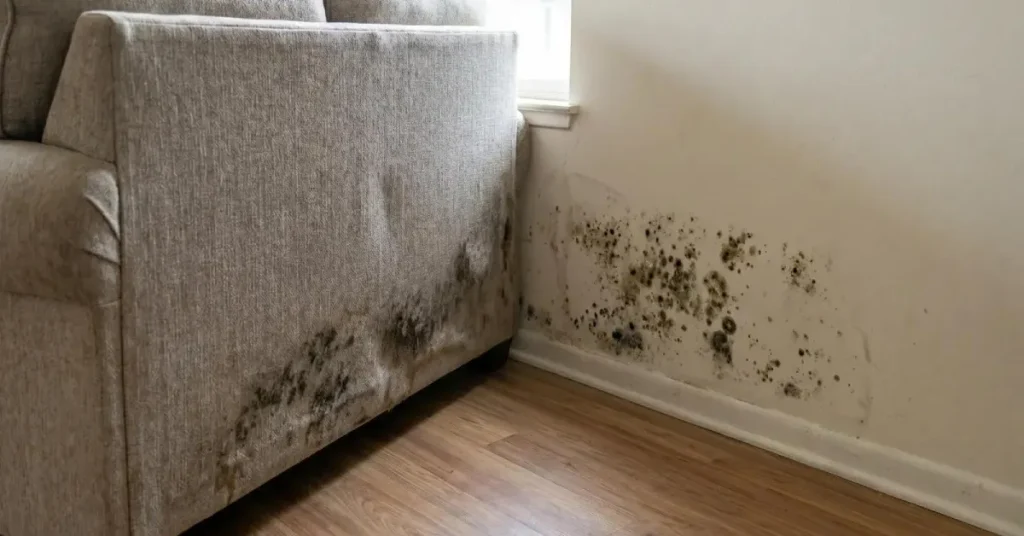
If you only read one section, read this: an air purifier can pull mold spores out of the air in a room, but it cannot fix a moisture problem, and no air purifier is a substitute for finding and removing an active mold source.
You searched for best air purifier for mold. Here’s the direct answer.
A HEPA air purifier with a true HEPA filter (rated to capture 99.97% of particles at 0.3 microns) will remove airborne mold spores effectively, because most mold spores measure roughly 1 to 40 microns, well within the range HEPA filters are built to catch (HomeCleanse, mold spore size data).
The catch is that filtration only manages spores that are already airborne. It does nothing about the colony growing behind your drywall or under your bathroom sink. The EPA is explicit about this: “Portable air cleaners and furnace/HVAC filters do not address the cause of mold and musty odors.” Below, we compare five HEPA purifiers with genuine third-party CADR verification, sized correctly for the room you’re actually trying to clear, and flag where a manufacturer’s marketing claim outruns the evidence behind it.
How We Evaluate Air Purifiers for Mold
We are not an independent test lab, and we did not run our own CADR measurements, decibel readings, or spore-count experiments for this guide. What we did instead: we pulled AHAM Verifide CADR numbers, published third-party lab reports, and manufacturer spec sheets for every product below, cross-checked them against verified owner reviews and outlets that do run in-house testing, and compared filter cost, room-size accuracy, and independent certification status.
Where a brand makes a claim we couldn’t verify against a real test or standard, we say so instead of repeating it as fact. This is a buying guide built on documented specifications and third-party verification, not a lab report.
Filter picks
#1
Top Air Purifiers for Mold
Quick Comparison
| Product | Best For | Price | CADR (Smoke/Dust/Pollen, cfm) | Filter Type | Noise (dB) |
|---|---|---|---|---|---|
| Coway Airmega 400 | Large rooms, basements | $389 | 328 / 328 / 400 (AHAM Verifide) | True HEPA (dual Max2 filters) | 22 dB (low) to ~52 dB (max) |
| Austin Air HealthMate Plus | Musty odor, chemically sensitive households | $895 | Not AHAM CADR-rated; sized to 1,500 sq ft | True medical-grade HEPA + activated carbon/zeolite blend | Not published by manufacturer |
| IQAir HealthPro Plus | Certified/verified performance | $1,199 | 213 cfm PM1 (top speed) | 3-stage: pre-filter, V5-Cell carbon, HyperHEPA | 36.9 dB (low) to 61.2 dB (max) |
| Levoit Core 600S | Budget, large open rooms | $319.99 | 375 (PM1) / 398 (AHAM PM2.5) | 3-stage cylindrical, particle + carbon | 37.9 dB (sleep) to 62.3 dB (max) |
| Blueair Blue Pure 311i+ Max | Quiet bedrooms | $299.99 | 220 (PM1) / 321 (AHAM PM2.5) | HEPASilent (fabric pre-filter + pleated particle + carbon) | 34.9 dB (sleep) to 57.7 dB (max) |
 #1
Best Overall for Mold-Prone Rooms
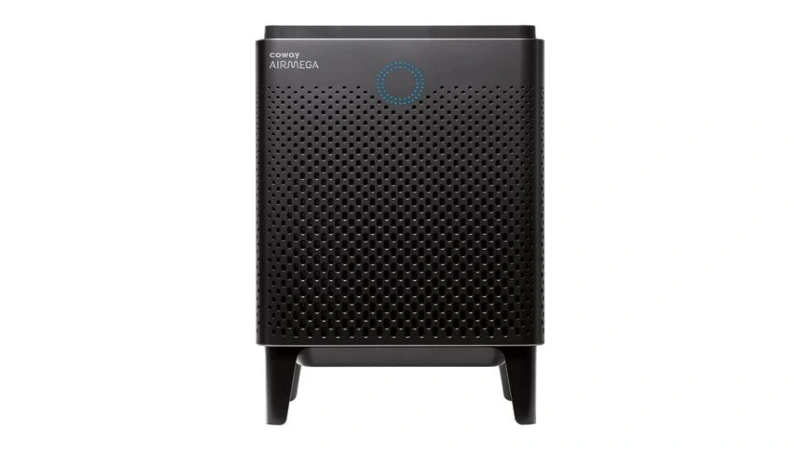
Coway Airmega 400
The Airmega 400 is the pick we’d point most people to. It carries an AHAM Verifide CADR of 400 (pollen), which is independently lab-tested rather than a manufacturer estimate. Coway rates it for 1,560 sq ft at standard turnover, though at the stricter 4.8 air-changes-per-hour standard that a mold-prone or damp room deserves, realistic coverage is closer to 620 sq ft, which still fits most basements, living rooms, or finished attics.
Pros
- AHAM Verifide CADR, independently tested
- Dual side-intake Max2 filters increase real-world airflow
- Quiet on low (22 dB) for bedroom use
Cons
- 5-year filter cost (~$1,034) is on the higher side
- Bulky footprint for smaller rooms
- App/smart features are a step behind some rivals
- Who it’s for: anyone dealing with a musty basement, a finished room over a crawlspace, or any space where you want AHAM-verified performance without paying premium prices.
- Key specs: AHAM Verifide CADR 328/328/400, True HEPA (dual Max2 filters), 1,560 sq ft manufacturer coverage / ~620 sq ft at 4.8 ACH, 22-52 dB, $389, filters ~$129/year.
 #2
Best for Musty Odor and Chemical Sensitivity
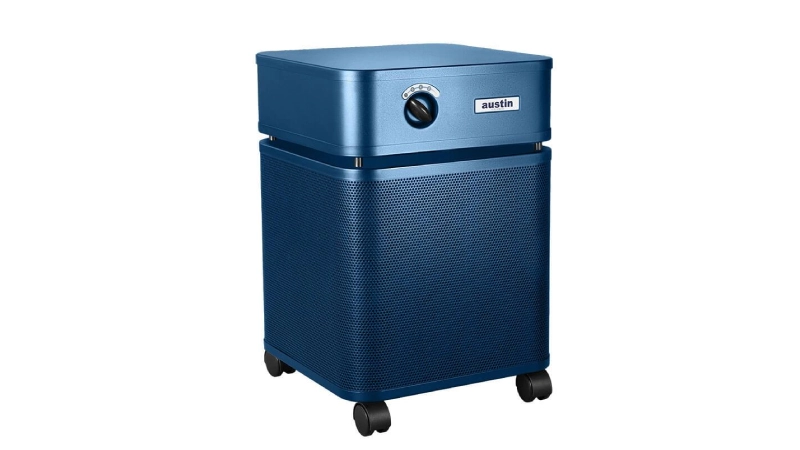
Austin Air HealthMate Plus
OdorsVOCs
This is the purifier people with severe mold reactions or MCS (multiple chemical sensitivity) tend to gravitate toward, and it’s built differently from most consumer purifiers on this list. Instead of a thin carbon layer, it packs over 780 cubic inches of activated carbon, potassium iodide-impregnated carbon, and zeolite alongside 60 sq ft of true medical-grade HEPA media rated to capture 99.97% of particles at 0.3 microns and 99% at 0.1 microns, per Austin Air’s own spec sheet. That carbon/zeolite load is aimed specifically at the musty MVOC (microbial volatile organic compound) smell mold produces, not just the spores.
Pros
- Heavy carbon/zeolite blend targets musty MVOC odor, not just particulates
- 5-year filter life reduces ongoing maintenance
- Steel construction, no plastic housing
Cons
- $895 price and steel housing make it a serious investment
- No published CADR or dB rating, harder to compare head-to-head
- Basic 3-speed control, no app or auto mode
- Who it’s for: households with a documented mold history, chemical sensitivity, or a persistent musty smell that lighter carbon filters haven’t touched.
- Key specs: True medical-grade HEPA (60 sq ft of media) + activated carbon/zeolite blend, rated to ~1,500 sq ft, 5-year filter life, $895, CSA approved.
Note: Austin Air does not publish an AHAM CADR rating or a decibel spec for this unit, which makes it harder to compare directly against AHAM Verifide competitors. Check the current spec sheet before buying if independent CADR verification matters to you.
 #3
Best Independently Verified Performance
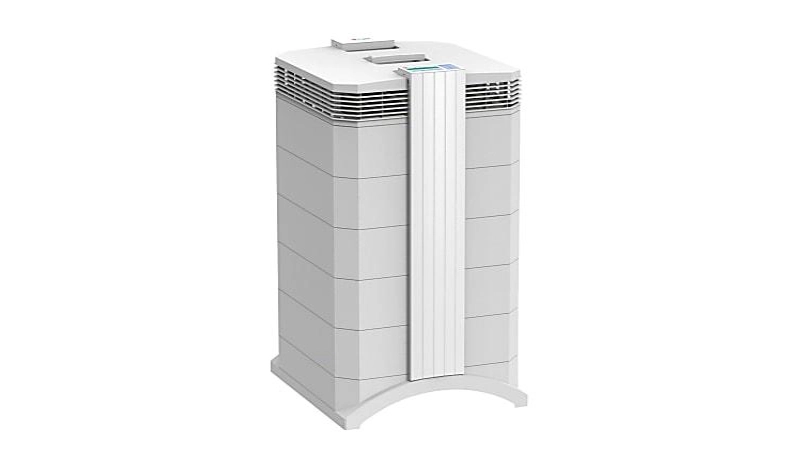
IQAir HealthPro Plus
IQAir’s HyperHEPA system is one of the few in this category backed by a published third-party lab report. Independent testing has confirmed 99 to 100% removal efficiency across particle types, and IQAir makes that report publicly available rather than just citing an internal number. That’s a meaningfully stronger form of verification than most brands offer.
Pros
- Third-party lab report is public, not just a marketing claim
- HyperHEPA filter targets ultrafine particles beyond standard HEPA range
- V5-Cell carbon stage adds real odor/VOC capacity
Cons
- $1,199 price, plus ~$200/year in filter costs
- Smaller rated coverage (319 sq ft at 5 ACH) than the price suggests
- Louder at top speed (61.2 dB) than some competitors
- Who it’s for: buyers who want documented, third-party-verified performance and are willing to pay for it, especially in a smaller room where coverage isn’t a limitation.
- Key specs: CADR 213 cfm (PM1, top speed), 319 sq ft at 5 ACH, 3-stage (pre-filter, V5-Cell carbon, HyperHEPA), 36.9-61.2 dB, $1,199, ~$200/year in filters.
 #4
Best Budget Pick for Large Rooms
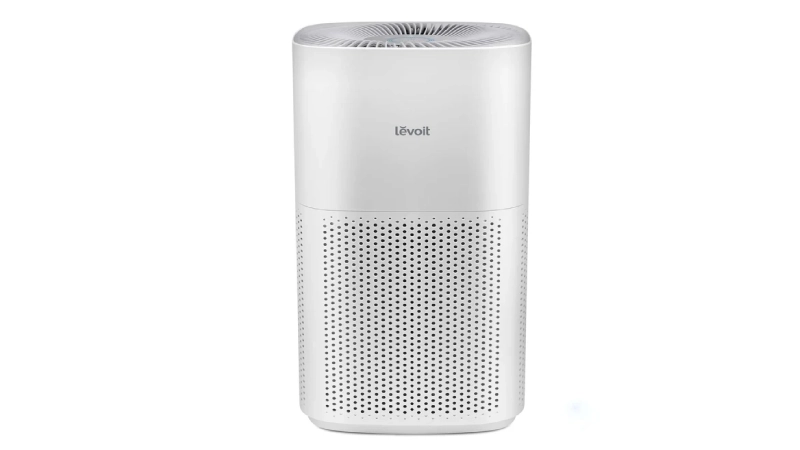
Levoit Core 600S
Large roomsBudget
On paper, the Core 600S looks like the best value here: an AHAM PM2.5 CADR of 398 cfm and a rated coverage of 562 sq ft at 5 ACH for around $320, based on independently tested specs.
Flagged marketing claim: Levoit has marketed versions of this filter as “HEPA H13,” but per independent reporting, the particle filter only meets that standard when the unit runs in sleep mode, and Levoit walked back its general HEPA H13 claims following a 2023 Better Business Bureau challenge. If HEPA H13-grade filtration at all fan speeds matters to your mold situation, verify the current claim on Levoit’s spec sheet before buying, rather than relying on older marketing copy.
Pros
- Strong CADR for the price (398 cfm AHAM)
- 562 sq ft coverage fits most bedrooms and basements
- Reasonably quiet at low speeds (37.9 dB sleep mode)
Cons
- HEPA H13 claim only holds in sleep mode, per independent reporting
- Bonded filter design means replacing the whole cartridge, carbon included
- Louder at top speed (62.3 dB) than the Blueair or Coway
- Who it’s for: budget-conscious buyers who want strong raw CADR numbers for a large room and don’t need premium build quality or a documented HEPA H13 claim.
- Key specs: CADR 375 cfm (PM1) / 398 cfm (AHAM PM2.5), 562 sq ft at 5 ACH, 3-stage cylindrical filter, 37.9-62.3 dB, $319.99, filters ~$60 each (roughly $120/year).
Best Air Purifier for Dorm Rooms in 2026 (What Actually Fits a 12×15 Room)
 #5
Best Quiet Option for Bedrooms
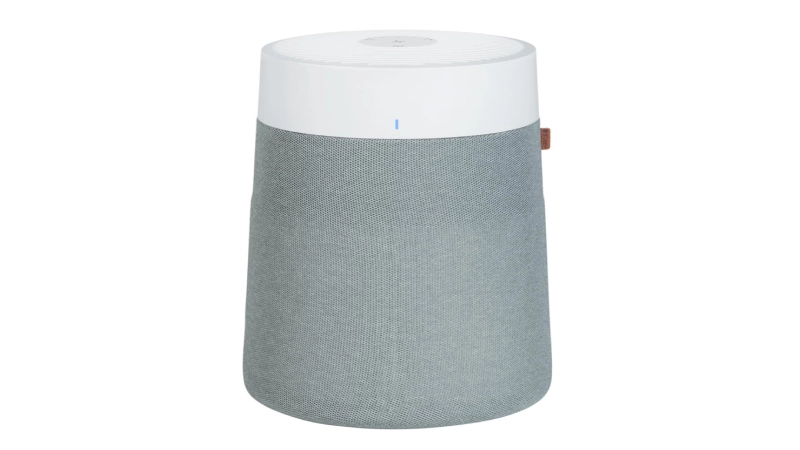
Blueair Blue Pure 311i+ Max
BedroomsQuiet
If mold is affecting a bedroom and noise is your deciding factor, this is the quietest unit on this list at the low end, running as low as 34.9 dB in sleep mode according to independent testing. Its AHAM-tested PM2.5 CADR of 321 cfm against a 330 sq ft rated room (at 5 ACH) is solid for a mid-size bedroom or home office.
Pros
- Quietest sleep-mode operation in this lineup (34.9 dB)
- AHAM-tested CADR, not just a manufacturer estimate
- Washable fabric pre-filter reduces some ongoing cost
Cons
- Built-in ionizer means checking UL 2998 zero-ozone status if that concerns you
- Smaller rated coverage (330 sq ft) than the Coway or Levoit
- Filters need replacing roughly every 6 months (~$44 each)
- Who it’s for: bedrooms, nurseries, or any space where nighttime noise matters more than maximum coverage.
- Key specs: CADR 220 cfm (PM1) / 321 cfm (AHAM PM2.5), 330 sq ft at 5 ACH, HEPASilent 3-layer filtration, 34.9-57.7 dB, $299.99, filters ~$44.49 every 6 months.
Buying Considerations: What Actually Matters When Choosing a Mold-Focused Air Purifier
CADR relative to room size, not just the marketing headline number. AHAM’s own guidance is the “2/3 rule”: your unit’s Smoke CADR should be at least two-thirds of your room’s square footage under standard conditions, and matched to full square footage for more demanding scenarios like wildfire smoke (AHAM Verifide standards). Manufacturer “coverage” claims are often based on a lower air-change standard than you’d want for an active mold or odor problem; look for coverage numbers calculated at 4-5 air changes per hour, and size down rather than up when in doubt.
True HEPA, and what that filter class actually captures. True HEPA is a filtration standard (99.97% of particles at 0.3 microns, the hardest particle size to trap), not a marketing term any manufacturer can apply loosely. Because most mold spores are larger than 0.3 microns, roughly 1-40 microns depending on species, a genuine true-HEPA filter typically captures them at rates higher than its 0.3-micron benchmark, since larger particles are easier to intercept mechanically.
AHAM Verifide is your best proxy for “is this CADR real.” Products carrying the AHAM Verifide seal have had their CADR independently tested in an accredited lab, rather than self-reported by the manufacturer. It’s the closest thing to a trustworthy, checkable performance number in this category. Energy Star certification is a secondary signal worth checking for units you’ll run continuously, since mold-prone rooms often call for round-the-clock operation.
Activated carbon matters more for mold than most buyers realize. The particles are only half the problem; the musty smell comes from MVOCs, which particulate HEPA filters don’t touch. A thin carbon pad will saturate quickly. If odor is a real issue, look for units with a substantial carbon or carbon/zeolite mass, like the Austin Air HealthMate Plus, rather than the token carbon layer bundled into most all-in-one filters.
Filtration is not remediation. This is the point most buying guides skip. The EPA’s guide to air cleaners states plainly that air cleaners “do not address the cause of mold and musty odors,” and the CDC’s mold guidance is built entirely around moisture control, not filtration, as the actual fix. If you have visible mold growth, a musty smell that won’t clear, or recent water damage, an air purifier is a supplement to fixing the moisture source and remediating visible growth, not a replacement for either. Running a dehumidifier to keep relative humidity under roughly 50% alongside your purifier addresses the cause; the purifier alone addresses only what’s already airborne.
Noise, if the room is a bedroom. Continuous operation is genuinely one of the more effective ways to control airborne spore counts, but that only works if the unit is quiet enough to run on low overnight. Check the low-speed dB rating specifically, not just the max-speed number brands tend to advertise.
Best Dehumidifier for Basement and Mold Control guide
FAQ
Do air purifiers actually remove mold spores from the air?
Yes, a true HEPA air purifier removes airborne mold spores effectively, since spores (roughly 1-40 microns) fall well within HEPA’s capture range. What it can’t do is stop mold from growing on a damp surface; that requires moisture control and, for visible growth, physical remediation (EPA).
What CADR do I need for a mold-affected room?
Follow AHAM’s 2/3 rule as a floor: pick a Smoke CADR at least two-thirds of your room’s square footage, and consider matching it to full square footage if the room has poor ventilation or a history of heavy mold (AHAM Verifide).
Should I use an air purifier or a dehumidifier for mold in my basement?
Both, ideally. A dehumidifier addresses the moisture that lets mold grow in the first place; a HEPA purifier reduces the spore count already circulating in the air. Neither replaces professional remediation if you have visible colony growth.
Is 99.9% mold removal on the box a verified claim?
Not necessarily. Treat any specific removal percentage as unverified unless it’s tied to a named, checkable third-party test, like AHAM Verifide CADR data or a published lab report (as IQAir provides for its HyperHEPA filter). A number with no cited test behind it is a marketing claim, not a certification.
Can an ionizer or UV-C feature in a purifier help with mold?
UV-C and ionization are marketed for pathogen and odor control, but their real-world effectiveness against mold specifically is inconsistent and harder to verify than HEPA filtration’s particle-capture performance. If a unit includes an ionizer, check for UL 2998 zero-ozone certification, since ionizing technology can produce ozone as a byproduct in uncertified units.
How often should I run an air purifier if I have a mold problem?
Continuously, in the affected room, especially while you’re addressing the moisture source. Spores are constantly being released by any active colony, so intermittent use lets counts rebuild between sessions.
Verdict
For most people dealing with mold-prone rooms, basements, or a persistent musty smell, the Coway Airmega 400 is the strongest overall choice: an AHAM Verifide CADR of 400, true HEPA filtration, and a price that doesn’t require a four-figure commitment. If odor and chemical sensitivity are the bigger issue rather than raw spore count, the Austin Air HealthMate Plus’s heavy carbon and zeolite load is worth the higher price. Whichever unit you choose, remember the one thing every manufacturer’s marketing page leaves out: an air purifier manages the symptom. Finding and fixing the moisture source is still the only real cure for mold.
Affiliate Disclosure: aquairpure.com may earn a commission from qualifying purchases made through links on this page, at no extra cost to you. This helps support our independent testing and research. Our recommendations are based on our own evaluation criteria, not on commission rates.
Keep reading
All posts →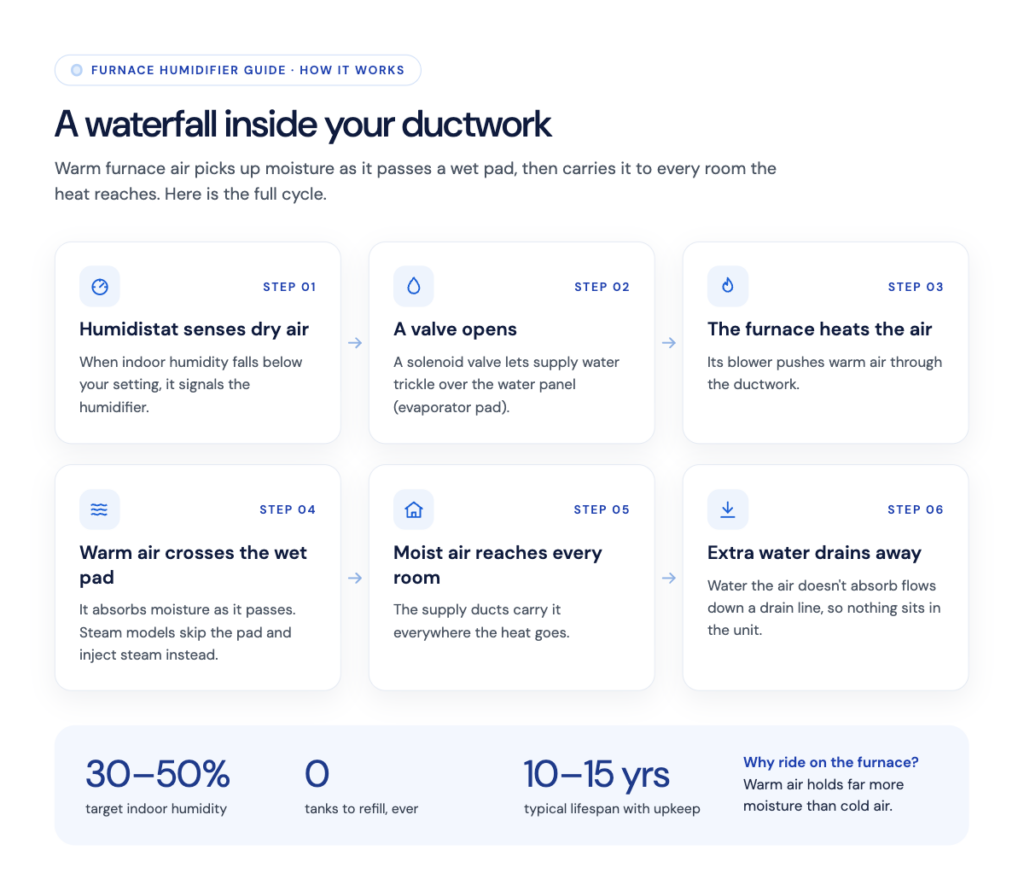 AIR
Humidifier on the Furnace: How It Works, Types, Costs and Whether You Need One
You turn the heat up, and somehow the house feels worse. Lips crack. Doorknobs bite back with a static zap. The hardwood…
Read article
 AIR
Best Air Purifier for Pets in 2026: Dander, Hair & Odor Picks
Our Top Pick Category Product Why It Wins Best Overall for Pet Owners Winix C909 Washable pre-filter, True HEPA, and real AHAM-verified…
Read article
 AIR
PFAS in Drinking Water: What the Numbers Say and What to Do
The question we get most about PFAS is not what are they? It is is it in my water, and does my…
Read article
 AIR
How to Remove Fluoride From Water: What Works (2026)
The question we get most about fluoride isn’t is it safe? I bought a filter pitcher, so the fluoride is gone, right?…
Read article