 #1
AirBlogs
5 Best Air Purifiers for Cat Litter Odors in 2026
 By aquairpure·
·10 min read
We may earn a commission when you buy through our links. It never affects our scores.
The best air purifier for cat litter odors in 2026 is the Alen BreatheSmart 75i with the Fresh filter, thanks to 3.6 lbs of pelleted activated carbon and quiet, room-filling airflow. If you’re on a budget, the Levoit Core 400S with the Smoke Remover filter gets you 450 g of carbon for under $200.
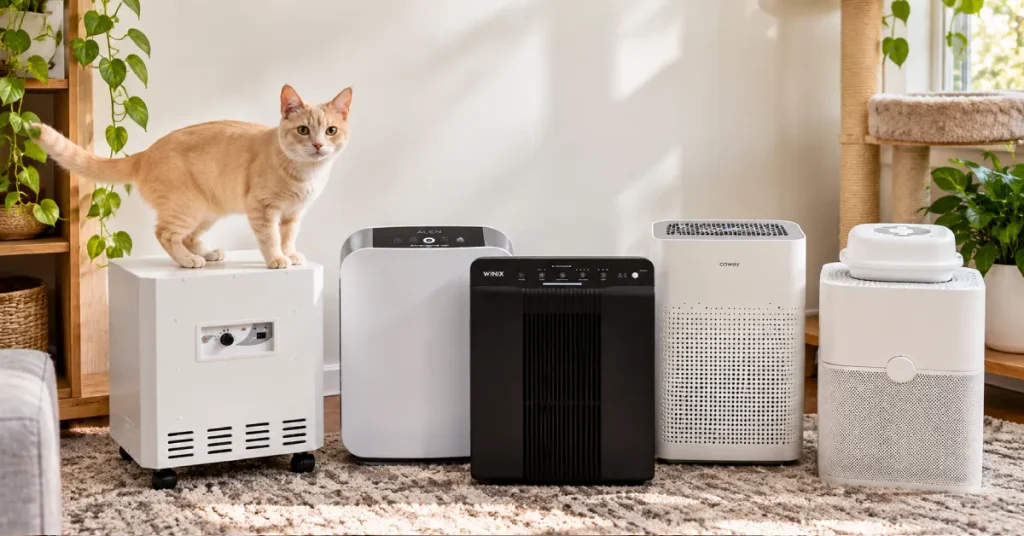
Litter box smell is a gas problem, not a dust problem. That one fact rules out most of the “pet” purifiers on Amazon. A HEPA filter catches litter dust and dander, but it does nothing for ammonia. Only a thick bed of activated carbon (or a similar adsorbent) pulls odor molecules out of the air. So we built this list around one question: how much real carbon does the purifier carry, and can it move enough air to use it? We cross-checked lab data from HouseFresh, RTINGS and Cats.com, then filtered out anything with a thin carbon sheet or an ionizer you can’t switch off.
Quick picks
- Best overallAlen BreatheSmart 75i (Fresh filter) — 3.6 lbs of carbon pellets, covers ~450 sq. ft.
- Best under $200Levoit Core 400S (Smoke Remover filter) — 450 g of carbon, smart auto mode
- Best for small apartmentsCoway Airmega Mighty2 — compact, carbon pellets, no ionizer
- Best for open-plan homesLevoit EverestAir — 400 g of carbon, ~560 sq. ft. coverage
- Best for multi-cat homesAustin Air HealthMate — 15 lbs of carbon and zeolite, 5-year filter
Comparison at a glance
Carbon weight is the number that matters most for litter smell; CADR and room size tell you whether the unit can actually reach it. Figures are HouseFresh’s measured PM1 CADR at top speed and room size at 5 air changes per hour.
| Purifier | Best for | Carbon | CADR (cfm) | Room size (sq. ft.) | Noise at top speed | Ionizer | Filter life |
|---|---|---|---|---|---|---|---|
| Alen BreatheSmart 75i (Fresh) | Best overall | 3.6 lbs pellets | 333 | 448 | 57.5 dBA | Yes, can be turned off | 12–15 months |
| Levoit Core 400S (Smoke Remover) | Under $200 | 450 g pellets | 249 | 373 | 60.3 dBA | None | 6 months |
| Coway Airmega Mighty2 | Small apartments | Carbon pellets (bonded) | 260 | 390 | 56.9 dBA | None | 6–12 months |
| Levoit EverestAir | Open-plan homes | 400 g pellets | 375 | 562 | 57.8 dBA | None | 12–15 months |
| Austin Air HealthMate | Multi-cat homes | 15 lbs carbon + zeolite | 160 | 169 | 61.5 dBA | None | 5 years |
Why litter boxes smell (and what a purifier can fix)
Litter smell comes from bacteria breaking down urine and feces. Urea in cat urine turns into ammonia within hours, and feces release sulfur compounds. Both are gases, which is why the smell drifts into the next room.
An air purifier tackles the problem in two ways:
- Activated carbon adsorbs the gases. Carbon has a huge internal surface area that traps odor molecules as air passes through. More carbon (and pellets rather than a dusted fabric sheet) means more capacity and a longer life before it saturates.
- HEPA-grade filters catch litter dust and dander. Fine clay dust can carry odor and irritate lungs. A particle filter removes it, but it won’t touch ammonia on its own.
What a purifier can’t do is replace scooping. If waste sits in the box, it will keep producing gas faster than any home unit can remove it. Think of the purifier as the second line of defense after daily scooping and a good unscented, clumping litter.
One more thing to avoid: ozone generators and always-on ionizers. They mask odors with ozone, a lung irritant. Cats have small, sensitive airways, so every pick below either has no ionizer or lets you switch it off without hurting performance.
The 5 best air purifiers for cat litter odors
Filter picks
#1Best overall
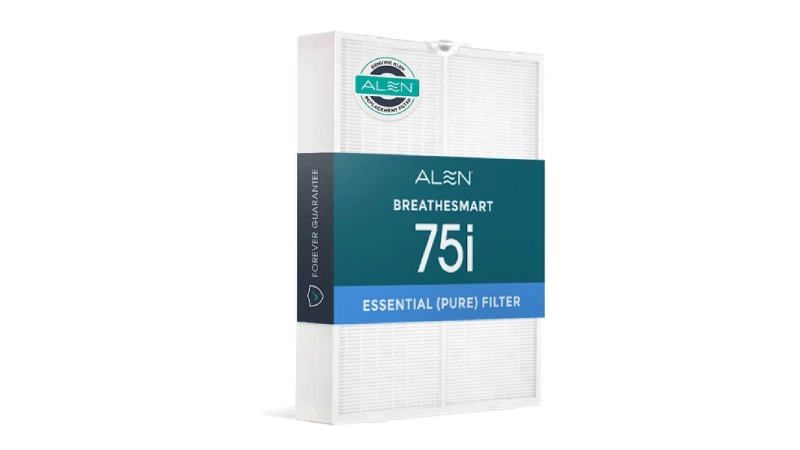
Alen BreatheSmart 75i (Fresh filter)
Smart
The 75i is the purifier we’d put next to a litter box in a living room. Its Fresh filter pairs an H13 HEPA layer with 3.6 lbs of pelleted activated carbon, several times what most mid-size units carry. In HouseFresh’s tests it delivered a 333 cfm PM1 CADR, enough for five air changes an hour in a 448 sq. ft. room.
It also stays strong when it’s quiet. At speed 2 it still pushes about 164 cfm at under 45 dBA, so you can leave it running all day without stressing your cat.
Pros
- Huge carbon bed for ammonia and stool odors
- Washable, easy-to-remove pre-filter for litter dust and fur
- Laser particle sensor with a color-coded air quality display
- Lifetime warranty when you buy filters from Alen
Cons
- Large and heavy (27 lbs); not for tight corners
- The cheapest “Pure” filter has no carbon – buy the Fresh or Odor filter
- Has an ionizer, though you can switch it off with no loss in performance
Best for: Most cat owners with one or two cats and a medium-to-large room.
 #2
Best under $200
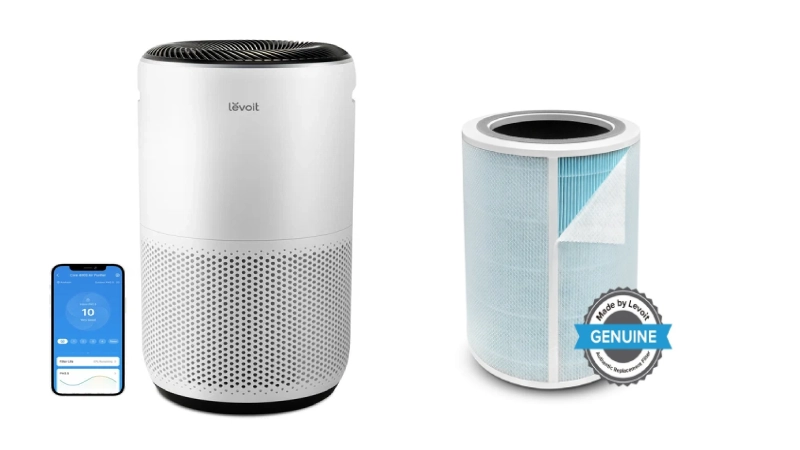
Levoit Core 400S (Smoke Remover filter)
Smoke
The Core 400S is the cheapest unit we’d trust with litter smell, provided you swap in the right filter. Levoit’s Smoke Remover filter carries 450 g of carbon pellets, about 50 g more than the Pet Allergy version, which makes it the better choice for odor.
It cleans up to 373 sq. ft. at 249 cfm and has a particle sensor, auto mode and app control. The cylindrical body has a small footprint, so it fits beside a litter cabinet.
Pros
- Strong performance for well under $200
- Most carbon in the Levoit range with the Smoke Remover filter
- Auto mode, air quality light and VeSync app
- No ionizer
Cons
- Bonded filter: you replace carbon and particle layers together every ~6 months
- Particle filter is no longer marketed as true HEPA (performance is still good)
- Avoid the look-alike PlasmaPro 400S, which adds an ionizer
Best for: Bedrooms, small living rooms and budget-conscious owners.
 #3
Best for small apartments
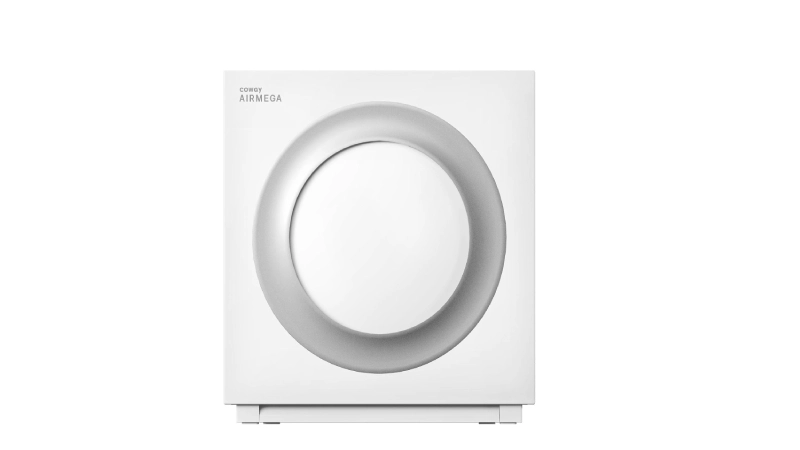
Coway Airmega Mighty2
Small rooms
The Mighty2 is Coway’s 2026 refresh of its best-selling compact unit, and it fixes the original’s biggest weakness. Instead of a carbon-dusted fabric, it now uses real carbon pellets bonded to a HEPA-grade layer.
It’s noticeably smaller than rival mid-size units yet still hits 260 cfm, enough for 390 sq. ft. Its pre-filter slides out from the side, so you can rinse off litter dust and fur without opening the cover. RTINGS also lists it among its top pet picks.
Pros
- Compact body for studios and small flats
- Slide-out, washable pre-filter keeps cleanup mess-free
- Fast laser sensor; no ionizer, so ozone-free
- 3-year warranty
Cons
- Bonded filter means replacing it all once the carbon saturates (6–9 months with cats)
- Smart mode drops to sleep when the room is dark; run it on speed 2 instead
- No app
Best for: Apartments where the litter box shares a room with you.
 #4
Best for open-plan homes
Levoit EverestAir
Large rooms
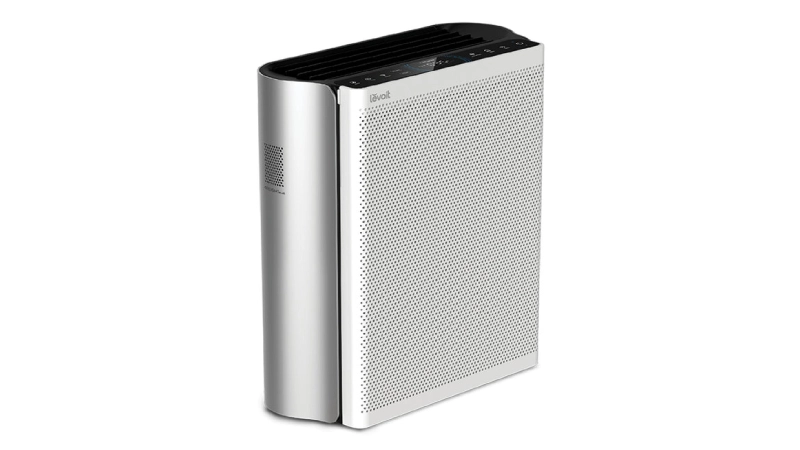
If your litter box sits in a large open kitchen-living space, you need airflow first. The EverestAir delivers a 375 cfm PM1 CADR, covering about 562 sq. ft. at five air changes an hour. Its bonded filter holds 400 g of carbon pellets behind a particle layer.
It’s also one of the quietest high-power units: at speed 2 it cleaned HouseFresh’s test room in 29 minutes at just 43.2 dBA.
Pros
- Fastest Levoit purifier tested; handles big rooms
- Easy-to-remove pre-filter for vacuuming fur
- App controls with display lock (handy with curious cats)
- No ionizer
Cons
- Pricier at around $500
- Moving vents; adjust them if your cat likes to lie on top
- Less carbon per sq. ft. than the Alen 75i
Best for: Large, open rooms and homes with one litter station.
 #5
Best for multi-cat homes
Austin Air HealthMate
Pets
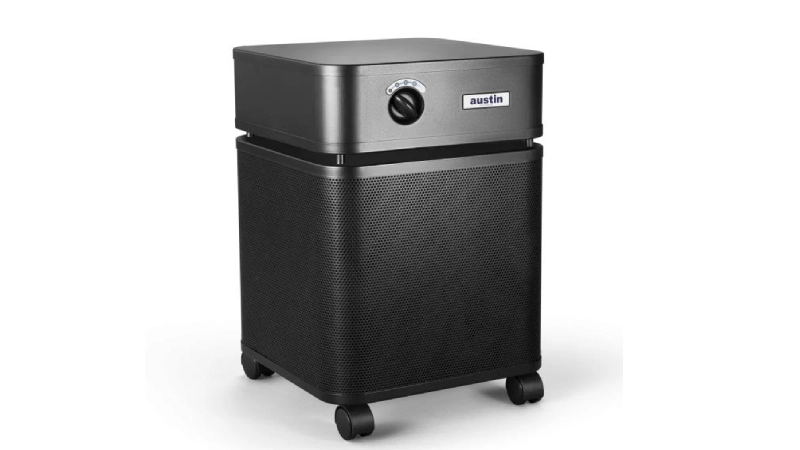
Three cats and three boxes is a different problem. The HealthMate packs 15 lbs of activated carbon and zeolite, the largest carbon load in the household purifier market. Zeolite is especially good at trapping ammonia, the main gas in cat urine.
The trade-off is particle power. Its 160 cfm CADR suits a room of about 170 sq. ft., so place it in the room with the boxes rather than expecting it to clean a whole floor.
Pros
- Unmatched odor capacity; filter lasts up to 5 years
- Made in the USA, all-metal body, 5-year warranty
- Simple dial controls that a cat can’t switch off
- Rolls well on carpet; no ionizer
Cons
- Power hungry (about 148 W at top speed)
- Replacement filter costs about $315 (though only every few years)
- Weak particle filtration for its size; no smart features
Best for: Multi-cat households and dedicated litter rooms.
Worth considering: two non-traditional options
Purrified Air Pet Odor Filter ($170) – Not a room purifier, but a small fan-and-adsorbent box that sits on top of a covered litter box or mounts on the wall beside it. Inside is a 2.2 lb mix of carbon, zeolite and other adsorbents that lasts 4–7 months. Cats.com tested it and rated it its top pick specifically for litter box odor. It draws only 3.6 W and catches smell at the source, so it pairs well with any purifier above. The downside: it’s always on, with little control.
DIY carbon scrubber (AC Infinity CLOUDLINE S8 + 8-inch carbon filter) – For severe odors, HouseFresh found this grow-tent fan and 16 lb refillable carbon filter beat even the Austin Air HealthMate in its VOC removal test. It does nothing for particles, so pair it with a budget HEPA unit. It’s cheaper than the HealthMate, and you can refill the carbon instead of buying new filters.
Honorable mention: The Winix C909, RTINGS’ top pick for pets overall, is a strong large-room particle cleaner. We left it off this list because its odor performance relies partly on PlasmaWave ionization; if you buy one, keep that feature off around cats.
Read More: Blueair Blue Pure 211i Max: A Complete Guide for Large Rooms
How to choose an air purifier for litter box smell
- Check the carbon weight, not the word carbon. Many purifiers list a carbon filter that is just fabric sprinkled with carbon dust. It saturates in weeks. Look for pelleted or granular carbon, ideally 400 g or more. If a brand won’t publish the weight, assume it’s small.
- Match CADR to your room. Aim for at least five air changes per hour. A rough rule: room size (sq. ft.) × ceiling height (ft.) × 5 ÷ 60 = the CADR (cfm) you need. A 300 sq. ft. room with 8 ft. ceilings needs about 200 cfm.
- Look for a washable pre-filter. Litter dust and fur clog the main filter fast. A pre-filter you can rinse or vacuum weekly protects the expensive layers.
- Skip ozone. Avoid ozone generators entirely and any ionizer, PlasmaWave or bipolar ionization feature you can’t switch off.
- Mind the noise. Cats hear far higher frequencies than we do and may avoid a box next to a loud unit. Check performance at speeds under 45 dBA, not just the top setting.
- Price in filter costs. Carbon wears out faster in a cat home. Compare yearly filter cost, and favor separate carbon and HEPA filters if you want to replace only what’s used up.
- Ignore HEPA-type claims. True HEPA is a performance grade. “HEPA-like” or “HEPA-style” filters don’t meet it.
Placement and maintenance tips
- Place it 3–6 feet from the box, not right beside it. Too close can startle your cat; too far lets the smell spread first.
- Leave clearance. Keep 12+ inches around the intake so airflow isn’t blocked by walls or furniture.
- Run it constantly on a quiet speed. Litter odor is continuous, so a steady low-to-medium speed beats short bursts on turbo.
- Clean the pre-filter weekly. Vacuum or rinse it to clear litter dust and fur.
- Replace carbon on time. If the smell creeps back before the filter light comes on, the carbon is saturated. Replace it early.
- Fix the source too. Scoop daily, change litter fully every 1–2 weeks, and wash the box with unscented soap. Low-dust, unscented clumping litter helps the purifier keep up.
FAQs
Do air purifiers really get rid of cat litter smell?
Yes, if they have enough activated carbon. A HEPA-only purifier will reduce litter dust but won’t remove ammonia. Pair a carbon-heavy purifier with daily scooping for the best results.
Is HEPA or carbon more important for litter odor?
Carbon. HEPA filters trap particles like dust and dander, while carbon adsorbs the gases that cause the smell. The best units have both, plus a pre-filter.
Are air purifiers safe for cats?
Filter-based purifiers are safe. Avoid ozone generators and keep any ionizer or PlasmaWave feature switched off, since ozone irritates airways.
Where should I put an air purifier for a litter box?
In the same room, about 3–6 feet away, with clear space around the intake. Avoid tucking it into a closet with the box, where airflow is poor.
How often should I change the carbon filter?
Every 6–12 months for most units, sooner in multi-cat homes. If odors return early, the carbon is full. The Austin Air HealthMate’s large filter lasts up to 5 years.
Can one purifier handle two or more litter boxes?
Only if the boxes are in the same room and the unit is sized for it. For several cats, choose the Austin Air HealthMate, or add a litter-box-mounted filter at each station.
Final verdict
For most cat owners, the Alen BreatheSmart 75i with the Fresh filter is the best air purifier for litter odors in 2026: it carries the most carbon of any mainstream pick and stays quiet enough to run all day. On a budget, get the Levoit Core 400S with the Smoke Remover filter. Living in a small flat? The Coway Airmega Mighty2 fits where others won’t. For big open rooms, choose the Levoit EverestAir, and for multi-cat homes, nothing beats the Austin Air HealthMate.
Whichever you pick, remember the rule that matters: more carbon, enough airflow, no ozone – and keep scooping.
Sources
Cats.com — 7 Best Air Purifiers for Cat Hair and Litter Dust (updated Sep 7, 2026)Oct 7, 2026 · @Sreeram
HouseFresh — The best air purifiers for pet odor, hair and dander (updated Aug 30, 2026)
RTINGS — The 6 Best Air Purifiers for Pets of 2026 (updated Aug 21, 2026)
Keep reading
All posts →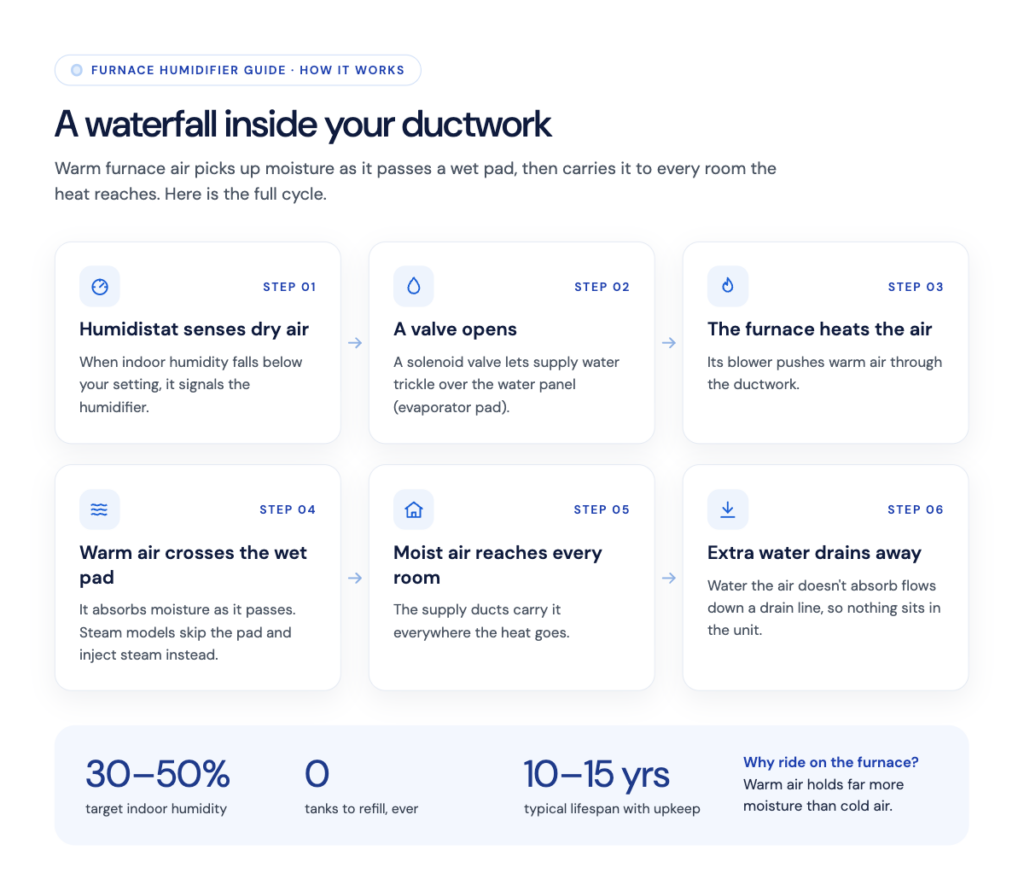 AIR
Humidifier on the Furnace: How It Works, Types, Costs and Whether You Need One
You turn the heat up, and somehow the house feels worse. Lips crack. Doorknobs bite back with a static zap. The hardwood…
Read article
 AIR
Best Air Purifier for Pets in 2026: Dander, Hair & Odor Picks
Our Top Pick Category Product Why It Wins Best Overall for Pet Owners Winix C909 Washable pre-filter, True HEPA, and real AHAM-verified…
Read article
 AIR
PFAS in Drinking Water: What the Numbers Say and What to Do
The question we get most about PFAS is not what are they? It is is it in my water, and does my…
Read article
 AIR
How to Remove Fluoride From Water: What Works (2026)
The question we get most about fluoride isn’t is it safe? I bought a filter pitcher, so the fluoride is gone, right?…
Read article