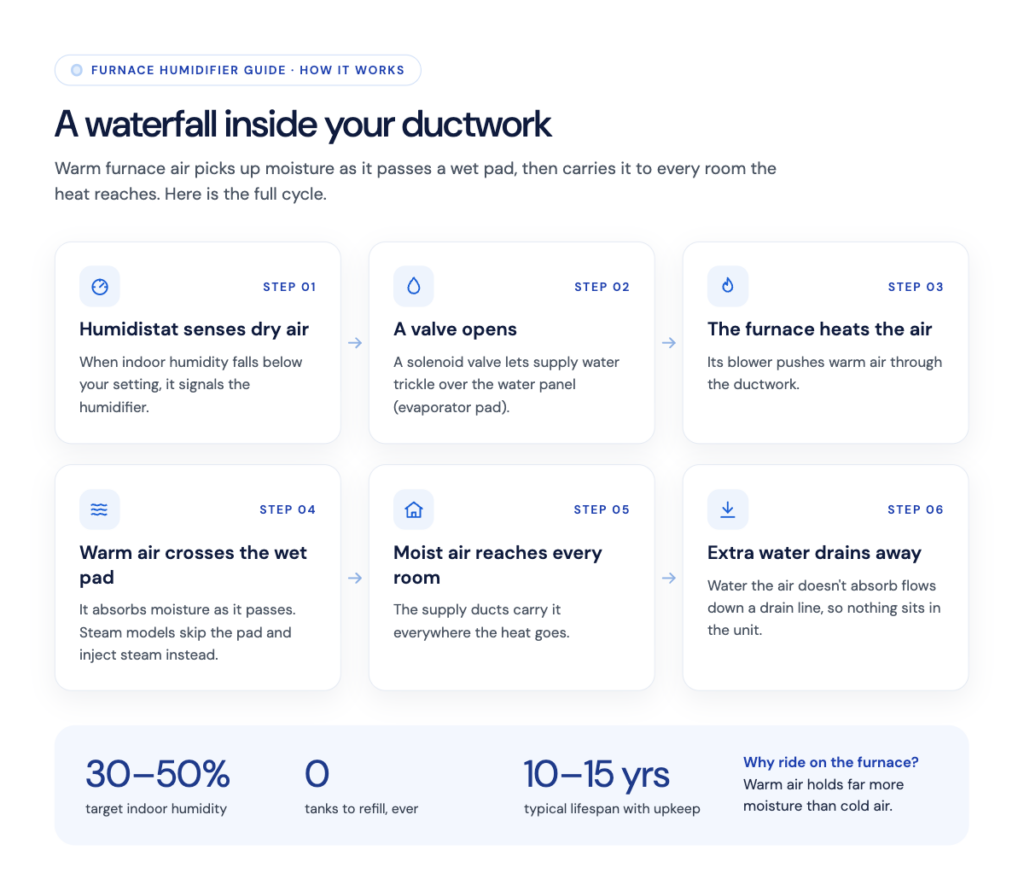
 AIR
Humidifier on the Furnace: How It Works, Types, Costs and Whether You Need One
You turn the heat up, and somehow the house feels worse. Lips crack. Doorknobs bite back with a static zap. The hardwood…
Read article
 By aquairpure·
·13 min read
We may earn a commission when you buy through our links. It never affects our scores.
Hard water is the most oversold problem in the water treatment industry. It is real, it costs you money in ways that are easy to underestimate, and the standard solution has drawbacks that almost nobody selling that solution will tell you about.
Here is the part that gets buried. A municipal water utility, Cleveland Water, publishes this about its own supply For residential customers, adding a whole-house water softener to your home’s plumbing system is not necessary. That is a water provider with no product to sell telling its customers to skip the hardware. Their reasoning is worth reading before you sign anything, and we get to it below.
USGS gives the cleanest definition: The simple definition of water hardness is the amount of dissolved calcium and magnesium in the water.” And on cause: “Hardness is caused by compounds of calcium and magnesium, and by a variety of other metals.” (USGS, Hardness of Water)
That is the whole thing. Rain falls essentially soft. As it moves through limestone, chalk and dolomite, it dissolves calcium and magnesium carbonates and arrives at your tap carrying them. Your hardness level is a readout of the rock your water passed through, which is why it is a regional property and why your neighbour’s number is almost certainly your number.
Hardness is not a contaminant in the regulatory sense. It appears on neither EPA’s primary standards nor its 15 secondary standards, which cover aluminium, chloride, colour, copper, corrosivity, fluoride, foaming agents, iron, manganese, odour, pH, silver, sulfate, total dissolved solids and zinc. (EPA, Drinking Water Regulations and Contaminants) There is no federal limit on hardness because there is no health basis for one.
Two units are in use and they cause endless confusion. Laboratories and utilities report milligrams per litre as calcium carbonate. American softener dealers use grains per gallon.
The conversion is fixed by the definitions of the units: one grain is 64.79891 mg and one US gallon is 3.785411784 litres, so
1 grain per gallon = 17.118 mg/L
Which is why you see the rule of thumb “divide mg/L by 17.1 to get grains.”
USGS classifies hardness as follows, and we have added the grain equivalents:
| Classification | mg/L as calcium carbonate | Grains per gallon |
|---|---|---|
| Soft | 0 to 60 | 0 to 3.5 |
| Moderately hard | 61 to 120 | 3.6 to 7.0 |
| Hard | 121 to 180 | 7.1 to 10.5 |
| Very hard | More than 180 | More than 10.5 |
mg/L classifications from USGS, Hardness of Water. Grain equivalents calculated at 17.118 mg/L per grain.
For a sanity check against a real supply: Cleveland Water states The hardness of Cleveland Water is 7 grains/gallon or 120 mg/L (milligrams per liter) as calcium carbonate. Seven grains times 17.118 is 119.8 mg/L, so their two figures agree, and their supply sits exactly on the boundary between moderately hard and hard.
A figure we are not going to repeat: a great many pages on this topic assert that 85 percent of US homes have hard water. We could not trace that number to a primary source with a date and a methodology, so we are leaving it out. If you want your own number, the two reliable routes are below.
In order of reliability.
1. Your utility’s annual report. If you are on a public supply, hardness is usually listed in the Consumer Confidence Report even though it is not a regulated parameter, because customers ask. This is free and it is a proper laboratory number. Our walkthrough is at How to Read Your Water Quality Report (CCR). If it is not on the report, phone the utility. They know.
2. A laboratory panel. On a private well there is no report, so hardness comes as part of the water panel you should be ordering annually anyway. See Well Water vs City Water and How to Test Your Tap Water at Home.
3. Hardness test strips. Genuinely useful for this one parameter, unlike most strips. Hardness is present in tens to hundreds of mg/L, which is well within what a colour strip can resolve, so the accuracy problem that ruins strips for lead does not apply here. Expect a band rather than a number.
4. The soap shake test. Fill a clear bottle one third with water, add a few drops of pure liquid soap, cap it and shake hard. Soft water throws a thick head of lather that persists. Hard water produces thin bubbles that collapse, and leaves the water looking cloudy or milky. This is a yes/no indicator and nothing more, but it costs nothing and it works on the actual chemistry: hardness minerals react with soap to form the insoluble scum that is also the reason your shower door looks like that.
5. Do not use a TDS meter for this. A TDS meter reports all dissolved ions together, hardness minerals included but mixed with sodium, chloride and bicarbonate. Two supplies with identical TDS readings can have completely different hardness. See What Is TDS? Is a TDS Meter Reliable?.
Most listicles give you ten signs with equal weight. They are not equal. Some are nearly conclusive, others have several possible causes.
Strongly diagnostic
Suggestive, with other possible causes
Weakly diagnostic, frequently overstated
If you have the first group, you have hard water. If you only have the third group, test before you treat.
USGS on the mechanism: when heated, hard water forms solid calcium carbonate deposits that “reduce the life of equipment, raise the costs of heating the water, lower the efficiency of electric water heaters, and clog pipes.”
Note that every item on that list is a plumbing and appliance cost, not a health cost. The real bill shows up as:
That is a genuine cost, and over a decade in very hard water it is not small. It is also the correct frame for the decision: softening is a household economics and convenience purchase, not a health purchase. Anyone selling it to you on health grounds is misrepresenting it.
USGS notes that Humans need minerals to stay healthy and on its page attributes the dietary point to the World Health Organization rather than to itself: WHO states that drinking water may be a contributor of calcium and magnesium in the diet.
Cleveland Water puts it more directly Hard water is not a health concern. In fact, the National Research Council states that drinking hard water generally contributes a small amount toward your total calcium and magnesium dietary needs.
A small amount is doing honest work in that sentence. Water is a minor contributor to mineral intake compared with food. But the direction is positive, not negative, and it is one reason removing hardness is a preference rather than an improvement.
This is the section the vendor pages do not have, and it is why we started with it.
Cleveland Water gives three specific objections to whole-house softening, in its own words.
Sodium. “A water softener that uses salt as part of this ion exchange process can result in you drinking 8 to 16 times more salt per glass of water than what you otherwise would.”
That is how ion exchange works: it does not remove calcium and magnesium so much as trade them for sodium. If anyone in the household is on a sodium-restricted diet, this matters, and it is the reason the standard installation advice is to leave the kitchen cold tap unsoftened.
Corrosion. “Removing minerals from your water also changes the water’s stability and can make it more corrosive. So if a softening system is installed where water enters your house, you could be corroding your home’s plumbing system.”
This one deserves attention in older homes specifically, because corrosive water is exactly what mobilises lead from lead solder, brass fittings and lead service lines. EPA on lead: it “can enter drinking water when plumbing materials that contain lead corrode, especially where the water has high acidity or low mineral content that corrodes pipes and fixtures.” A softener installed at the point of entry in a pre-1986 house is a change to your water’s corrosivity in a building that may have lead in the plumbing. See Lead in Drinking Water.
Necessity. For residential customers, adding a whole-house water softener to your home’s plumbing system is not necessary.
Source for all three: Cleveland Water, What is Hard Water and Should You Worry About It
To be fair to the other side: Cleveland’s water is 120 mg/L, the boundary of moderately hard. A utility at 350 mg/L would probably write a different article. Hardness decisions scale with your actual number, which is the whole reason the first job on this page is to find out what yours is.
| Option | How it works | Best when | Watch out for |
|---|---|---|---|
| Do nothing, descale periodically | Vinegar or citric acid on kettles, shower heads, aerators | Moderately hard water, 61 to 120 mg/L, and you do not mind the chore | Does nothing for the water heater interior or pipes |
| Ion-exchange softener (salt) | Resin swaps calcium and magnesium for sodium, regenerated with brine | Genuinely hard to very hard water, above roughly 180 mg/L, with visible appliance damage | Adds sodium, increases corrosivity, needs salt and produces brine discharge. Look for NSF/ANSI 44 certification |
| Salt-free “conditioner” (TAC or similar) | Alters crystal formation so scale is less adherent. Does not remove hardness | You want less scale without sodium or brine, and can accept a partial result | Your hardness reading will not change, because nothing is removed. Claims in this category are frequently unsupported |
| Point-of-use reverse osmosis | Membrane removes most dissolved minerals from drinking water only | You want soft, low-mineral drinking and cooking water without touching the whole house | Does nothing for your water heater, shower or laundry. See How Reverse Osmosis Works |
| Whole-house RO | Rarely appropriate | Almost never in a normal home | Water waste, cost, and corrosivity of demineralised water throughout the plumbing |
AquaAirPure guidance, not a published standard. Our rough decision rule, and we label it as ours because no standards body publishes one:
If you install one:
Yes. Hardness has no federal limit because there is no health basis for one, and the mineral contribution to your diet is small but positive.
For most people yes, but it carries more sodium than the original water, by Cleveland Water’s estimate 8 to 16 times more per glass. If anyone in the household is on a sodium-restricted diet, keep the kitchen cold tap unsoftened, or drink from a point-of-use RO or carbon filter instead.
There is no good evidence that it does. What hard water reliably does is leave soap residue on hair and skin, which changes how hair feels and looks. That is a different claim from hair loss.
Partially and temporarily. Boiling precipitates carbonate hardness as the scale you then find in the kettle, so the water poured off is slightly softer. It does nothing to non-carbonate hardness and it is not a household treatment method.
A carbon filter does not. Hardness minerals pass straight through activated carbon. Removing hardness requires ion exchange, reverse osmosis or distillation. See Water Softener vs Water Filter.
Will a softener lower my TDS reading? Almost not at all. Ion exchange trades calcium and magnesium ions for sodium ions, so the total dissolved solids stay roughly the same. A meter that barely moves across a softener is evidence the softener is working as designed, not evidence it is broken.
My water is hard and also smells of sulfur and stains things orange. Same problem? No, three separate problems. Hardness is calcium and magnesium. Orange staining is iron. Rotten-egg smell is hydrogen sulfide. On a well these often arrive together, and the treatment order matters: oxidising and iron removal stages go ahead of the softener, because iron fouls softener resin.
Find your number first, in mg/L or grains, from your utility’s report or a lab panel. Under 120 mg/L, descale occasionally and spend your money elsewhere. Above 180 mg/L with appliances failing early, a softener is a reasonable economic decision, made with open eyes about the sodium, the brine and the corrosivity, and with one unsoftened tap kept for drinking. And whatever a salesperson tells you, hardness is not a health problem. It is a scale and soap problem that happens to be measurable, which is exactly what makes it so easy to sell.
AIR
You turn the heat up, and somehow the house feels worse. Lips crack. Doorknobs bite back with a static zap. The hardwood…
 AIR
Our Top Pick Category Product Why It Wins Best Overall for Pet Owners Winix C909 Washable pre-filter, True HEPA, and real AHAM-verified…
 AIR
The question we get most about PFAS is not what are they? It is is it in my water, and does my…
 AIR
The question we get most about fluoride isn’t is it safe? I bought a filter pitcher, so the fluoride is gone, right?…